




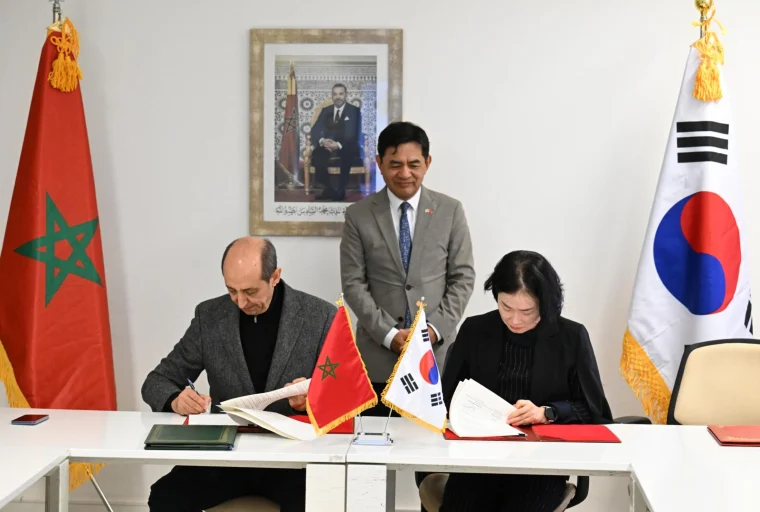
A protocol agreement marking the launch of the project “Promoting Industrial Decarbonization and Capacity Building in Morocco (2026-2030)” was signed on Tuesday in Rabat between the Moroccan Agency for Energy Efficiency (AMEE) and the Korean International Cooperation Agency (KOICA).
Signed by AMEE Director General Mohamed Benyahia and KOICA’s resident representative in Morocco, Hyewon Cho, in the presence of the Ambassador of the Republic of Korea to Morocco, Yeonjean Yoon, this agreement illustrates the strong partnership between the two countries and their shared commitment to sustainable development and climate action.
With a total budget of $13.5 million, the project, which will be implemented in partnership with the United Nations Industrial Development Organization (UNIDO) and the International Labour Organization (ILO), aims to accelerate the decarbonization of the Moroccan industry through enhancing energy efficiency in key sectors, strengthening training capacities, and expanding access to green jobs for youth and women.
Speaking on this occasion, Mr. Benyahia indicated that this initiative fully aligns with the exemplary relations established between Morocco and the Republic of Korea.
“This project reflects the maturity of our cooperation and the convergence of our strategic priorities regarding energy transition, climate action, and sustainable development,” he stated, noting that it is based on three structural pillars.
These include conducting energy audits accompanied by tailored training for companies in the agri-food, textile, chemical, and pharmaceutical sectors, enhancing training capacity, particularly through equipping the AMEE training center and developing new specialized modules, in addition to promoting green jobs.
Ultimately, this project, which aligns with Morocco’s strategic objectives, is expected to significantly contribute to achieving national energy efficiency goals and further strengthen bilateral relations by placing them within a high-added-value partnership based on expertise, innovation, and technology transfer, highlighted Mr. Benyahia.
For his part, Mr. Yoon stated that “this initiative demonstrates the importance and sustainability of the partnership between the Republic of Korea and the Kingdom of Morocco.”
More than just a technical cooperation, the project exemplifies a strategic partnership that merges industry and human resources, likely to contribute to combating climate change, enhancing national competitiveness, and fostering social inclusion, particularly through improving energy efficiency in industries and boosting the expertise of relevant institutions, he explained.
He also reiterated Korea’s determination to continue working alongside Morocco, which “is now emerging as a leader in the renewable energy field, thanks to its bold policies and investments.” The goal, he said, is to build a resilient and low-carbon future together.
Ms. Cho noted that this project is a natural extension of KOICA’s efforts, reflecting the Republic of Korea’s commitment to supporting Morocco’s climate ambitions and the development of a decarbonized industry.
“By sharing technologies, expertise, and experiences, we aspire to contribute to capacity building and accelerate Morocco’s green transition,” she asserted.
The representative of UNIDO, Sanae Lahlou, emphasized the importance of this collaboration in facilitating young people’s access to decent green jobs.
In this regard, she specified that the synergies created between Moroccan and Korean actors and those from UNIDO are likely to enable the creation of a greener, inclusive, and sustainable industry in Morocco.
She also expressed the Organization’s determination to support efforts for the decarbonization of the Moroccan industry by leveraging its expertise in modernizing vocational training.
This collaboration is also expected to generate a strong energy and environmental impact while promoting decent work, according to Aurellia Segatti, ILO focal point for Morocco, who believes that a green economy and decent work are essential conditions for social justice and sustainable peace.
The protocol agreement concluded between AMEE and KOICA reflects the joint commitment of Morocco and Korea to a sustainable energy and climate transition.
In the long term, the project is expected to generate an energy and environmental impact likely to support the implementation of Morocco’s energy efficiency and sustainable development strategies.
MAP