






In its latest report on food security, the World Bank cites Morocco as a model of technological and financial success. Thanks to an unprecedented risk-sharing mechanism, 30,000 farmers in the Kingdom are expected to transition to solar and smart irrigation by 2027.
Feeding 10 billion people by 2050 while conserving increasingly scarce water resources is the impossible equation the World Bank Group is attempting to solve in its report “Feed and Prosper.” Amid global solutions, a Moroccan initiative stands out as a “replicable” model on an international scale.
Risk Sharing: The Secret to Financial Inclusion
The primary obstacle to agricultural modernization is often credit risk. To overcome this challenge, Morocco has established a risk-sharing facility among three key players: Banque Centrale Populaire (BCP), CMGP (the national leader in irrigation), and the International Finance Corporation (IFC).
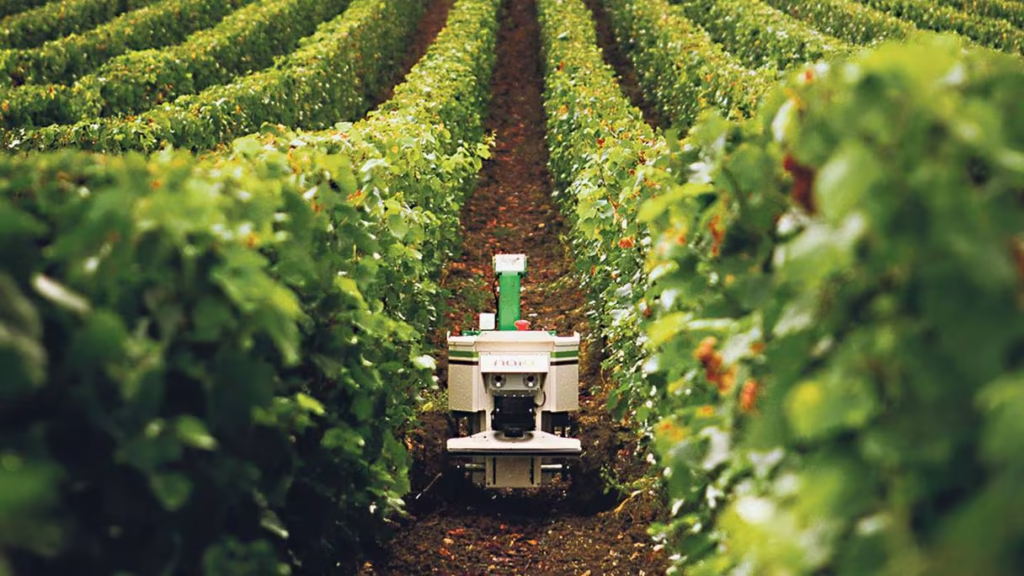
This framework reassures banks and opens the credit floodgates for small farmers and rural SMEs. The goal is to finance the installation of drip irrigation systems and solar pumping, thus replacing engines that are dependent on fossil fuels.
30,000 Beneficiaries by 2027
The anticipated impact is substantial. By 2027, nearly 30,000 farmers are expected to have transformed their practices. This shift to precision irrigation not only drastically reduces water consumption but also lowers operating costs through solar energy, thereby directly improving farmers’ incomes.
Morocco: A Pioneer in Water Innovation
According to the World Bank, the Moroccan example illustrates the importance of public-private partnerships for successfully achieving ecological transition. While the Kingdom is already receiving German support of €100 million to reform its water governance (including desalination and integrated management), this agricultural component complements the national resilience strategy.
A Global Challenge: Reorienting Subsidies
The report emphasizes that the current global agricultural system can only sustainably feed half of the population. To bridge this gap, the World Bank recommends:
- Massive investments: Between $24 billion and $70 billion more annually by 2050 to modernize irrigation.
- Reform of subsidies: Redirecting a portion of the $490 billion in global agricultural subsidies towards productive and sustainable technologies.
- Deployment of AgriConnect: An initiative to transform smallholders into players in commercial agriculture.
By doubling its funding for agri-food (to $9 billion annually by 2030), the World Bank confirms that the future of global food will rely on solutions inspired by the Moroccan trajectory: a mix of green energy, circular economy, and inclusive financial engineering.