

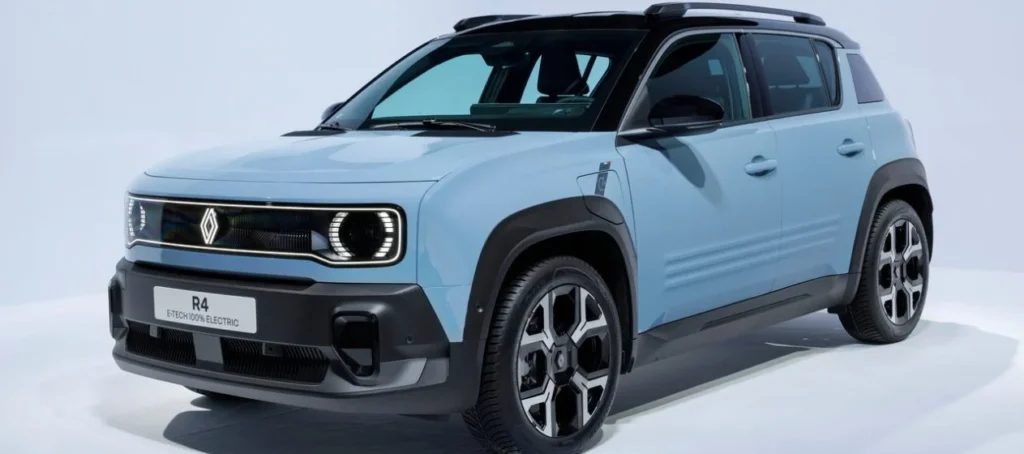
While Renault boasts about the efficiency of its new Renault 4 e-Tech, especially compared to its sister model the Renault 5 e-Tech, the reality regarding electric consumption raises serious doubts. Between official data and real-world measurements, it’s time to set the record straight.
Built on the same technical platform, named AmpR Small, derived from the CMF B EV used for the Clio 5, the Renault 4 e-Tech shares batteries, electric motor, and other components with the Renault 5 e-Tech. However, despite these common elements, the brand claims that the 4 would be more economical than the 5, thanks in particular to efforts on aerodynamics and weight.
During the international presentation, Renault proudly stated that it had limited the overconsumption related to the more compact size of the 4, with only 0.5 kWh/100 km more than the 5 in WLTP homologation, resulting in a reduced range of about 13 km. But the official figures compared to road measurements seem to indicate a completely different scenario.
Indeed, the first measurements taken under real conditions show a lower average consumption on the Renault 4, with a difference of nearly 1.7 kWh/100 km in favor of the smaller sister. This finding, confirmed by several rigorous tests — on urban, highway, or mixed circuits — calls into question the validity of the WLTP standard and especially the figures communicated to drivers.
But a major problem emerges: the consumption displayed by the Renault 4 e-Tech on the dashboard is systematically lower than the actual consumption recorded at the battery level, with an average gap of 2.2 kWh/100 km. In practical terms, the car indicates it consumes less energy than it actually draws. This phenomenon is not observed on the Renault 5 e-Tech, whose displayed values perfectly match the real data.
This unexplained discrepancy could stem from a miscalibration of the onboard computer system, rather than an issue related to driving modes (One-Pedal) or aerodynamic devices. Tests also rule out an error related to air conditioning management or battery gauge.
As a result: even if the Renault 4 e-Tech presents itself as more economical, it actually consumes a bit more than the Renault 5 e-Tech — about 0.5 kWh/100 km more on average according to our measurements. This overconsumption corresponds precisely to that announced by the WLTP standard, dispelling the illusion of superior efficiency.
While this gap remains minimal and has little impact on the user in daily life, it raises questions of honesty and transparency in the display of consumption and range, key data for buyers of electric cars.
Pending a possible corrective update of the onboard software, it should be kept in mind that the Renault 4 e-Tech is not a “magical” car in terms of energy efficiency. It remains, physically and technically, very close to the Renault 5 e-Tech from which it is derived.
We will provide a complete test in the fall, with all the precise data on range and consumption, to shed light on this awaited car.