

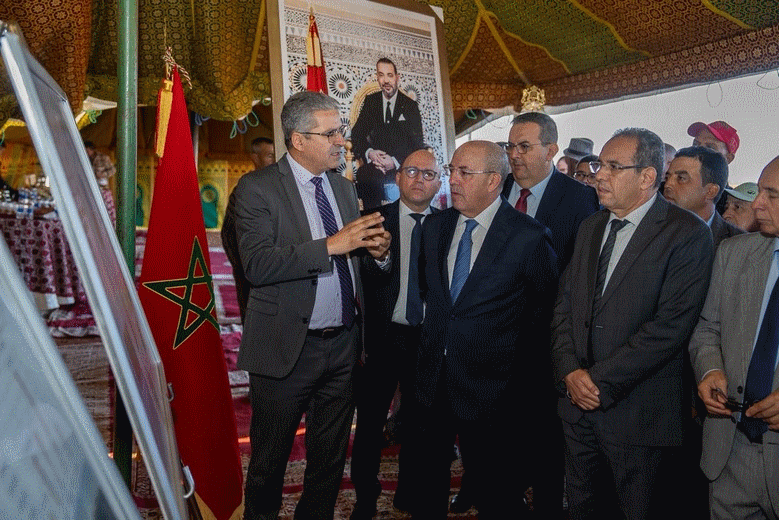
The Minister of Agriculture, Maritime Fisheries, Rural Development, and Water and Forests, Ahmed El Bouari, conducted a field visit on Wednesday in the provinces of El Jadida and Benslimane, which fall under the Casablanca-Settat region.
This visit focused on the progress of three key agricultural programs as part of the implementation of the “Green Generation 2020–2030” strategy, aimed at enhancing climate resilience, sustainability of production systems, improving agricultural incomes, and creating economic opportunities in rural areas.
The programs include the national cactus planting initiative resistant to cochineal, the national direct seeding program, and an integrated irrigation development program for cereal crops.
In a statement to the press, the minister explained that these “three structural projects align with the Green Generation strategy and aim to support farmers and strengthen the resilience of our agriculture in the context of climate change.”
Regarding the national cactus planting program over an area of 122,000 hectares, Mr. El Bouari stated that 50% of the set targets have been achieved to date, with plans to reach 100% of objectives by 2027.
The second project focuses on the rollout of direct seeding, with a target of one million hectares by 2030, noting that this technique is particularly water-efficient.
“To ensure good cereal yields, we have launched a complementary irrigation development program covering one million hectares of cereals to bolster our food sovereignty and guarantee a harvest of 70 to 80 million quintals, regardless of rainfall conditions,” he emphasized.
In a statement to the MAP, the national coordinator of the cactus multiplication program resistant to cochineal at the National Institute for Agronomic Research (INRA), Mohamed Sbaghi, indicated that the ministry has implemented an emergency program based on rapid chemical treatments, uprooting and burying infested plants, as well as a research program assigned to INRA, focusing on biological control, natural products, and the selection of resistant varieties.
Sbaghi specified that through close collaboration between the central and regional structures of the ministry, INRA has managed to identify eight resistant cactus varieties, which have since been included in Morocco’s official seed variety catalog, a significant advancement for the reconstruction and sustainability of this strategic sector.
He added that in 2017, the Institute established a “base material woody park” in Zemamra, from which eleven national platforms for multiplying plant material were set up, addressing the initial shortage of resistant plants and enabling large-scale planting.
The national coordinator also reported the production of over 16.3 million plants between 2021 and 2025, noting that starting in 2026, annual production will reach six million plants aimed at reconstituting 122,000 hectares by 2028, with an estimated investment of 1.4 billion dirhams, in addition to another 100,000 hectares currently under study.
The cactus sector is among the priority sectors of the Green Generation strategy, due to its significant economic, social, and environmental roles, particularly in arid and semi-arid regions. In the Doukkala area, 1,600 hectares are planned for planting, of which 880 hectares have been completed to date.
As part of the agroecological transition, the ministry launched a national direct seeding program in 2021, aimed at reaching one million hectares by 2030.
Since the start of the program, 169,000 hectares have been cultivated using direct seeding, with yields showing a significant increase compared to conventional sowing, confirming the economic viability and technical relevance of this practice.
At the national level, the program mobilizes 866 seeders benefiting 400 agricultural cooperatives, with a total investment of 54 million dirhams, of which 11 million dirhams have been allocated by the Agricultural Development Fund.
In the province of Benslimane, the minister, accompanied by the governor of the province, El Hassan Boukouta, observed a presentation on the complementary irrigation development program for cereals. Aiming for a potential of one million hectares, this program seeks to mitigate the volatility of cereal production and strengthen national food security.
This program relies on securing water needs for cereal crops in existing irrigated areas covering 500,000 hectares, and the development of an additional 500,000 hectares in major cereal plains.
In the Casablanca-Settat region, this program includes the construction of water supply and distribution infrastructure from the Bouregreg-Oum Errabia interconnection project, aiming to develop supplemental irrigation over approximately 100,000 hectares. This initiative will promote the development of high-productivity cereal areas based on cereal/legume rotations and contribute to more balanced and sustainable territorial development.
MAP