



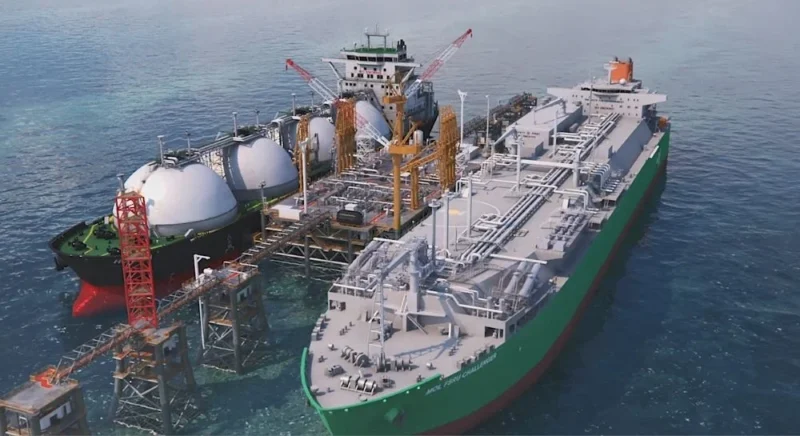
Turkish industrial and maritime sectors are showing strong interest in the international pre-selection procedure launched by Morocco for the chartering of a floating storage and regasification unit (FSRU) intended for the future Nador West Med port. This operation is part of the national strategy to diversify energy supply sources and gradually reduce dependence on coal.
According to official documents relayed by sectoral sources, Ankara has mobilized its professional networks to encourage specialized Turkish companies to position themselves for this key project. A circular dated January 7, from the General Secretariat of the Exporters’ Unions of Istanbul, was sent to members of the Union of Ship, Yacht, and Services Exporters, inviting them to participate in the procedure initiated by the Moroccan authorities.
This initiative is supported by an official transmission from the office of the Turkish Commercial Counselor in Rabat, relayed by the General Directorate of Exports of the Turkish Ministry of Commerce. The documents emphasize that the Moroccan Ministry of Energy Transition and Sustainable Development has opened a pre-selection procedure for the leasing, in the form of a time charter, of a floating unit intended to ensure the reception, temporary storage, and regasification of liquefied natural gas at the Nador West Med port.
The Nador West Med port, currently in advanced construction on the Mediterranean coast, is set to become operational in the second half of 2026. Designed as a large-scale industrial and energy hub, it will eventually develop nearly 800 hectares of industrial zones, with a potential extension reaching 5,000 hectares. It will host Morocco’s first LNG terminal, relying on an FSRU connected via pipeline to the industrial poles in the northwest of the country.
Turkish documents highlight a favorable aspect for Ankara’s operators: the involvement of Turkish companies in the construction of the Nador West Med port, viewed as a factor for technical and operational familiarity with the site. This infrastructure is expected to play a central role in securing gas supplies amid the rising significance of natural gas as a transition energy source, alongside the development of renewable energies.
Beyond the floating unit itself, the project includes extensive technical obligations. The selected operator may be tasked with the realization of all or part of the surface equipment, including quayside interfaces, connection systems, and ancillary equipment. These installations must be handed over to the Moroccan authorities before commissioning, reflecting the state’s intention to maintain ownership of strategic infrastructures.
The official pre-selection notice specifies that the procedure aims to restrict access to the next phase to operators with proven technical, financial, and operational capacities. The requirements particularly focus on storage capacity, regasification flow rate, safety standards, and compatibility with existing port facilities.
Interested companies may collect application files until January 30, which is also the deadline for submission of bids at 2:00 PM Rabat time. Through this operation, Morocco seeks to gradually structure its future gas system, while Turkey aims to position itself as a leading industrial partner.