




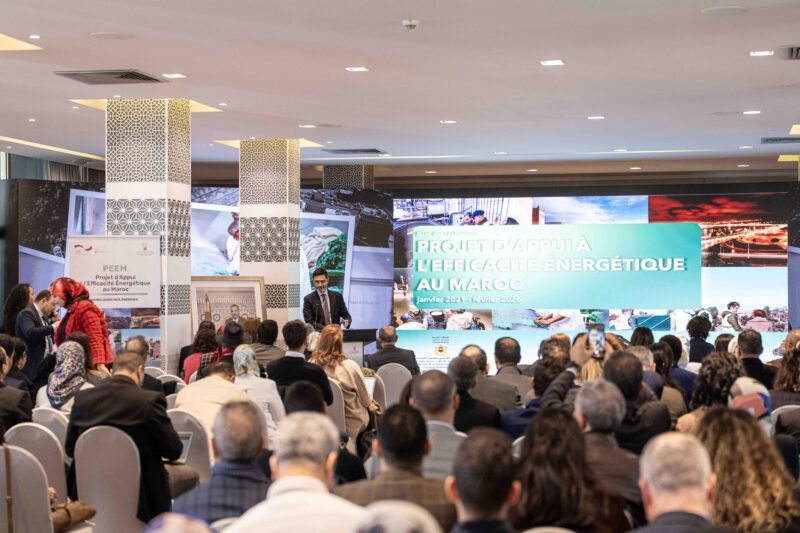
The energy partnership between Morocco and Germany has taken a new step forward. Meeting in Rabat on February 17, 2026, a group of Moroccan and German officials marked the conclusion of the Energy Efficiency Support Project in Morocco (PEEM I) and officially launched its second phase, PEEM II, which will cover the period from 2026 to 2028.
Presided over by the Secretary General of the Energy Transition Department, Mohamed Ouhmed, the ceremony brought together the German Ambassador to Morocco, the Director General of AMEE, the Resident Director of GIZ, as well as several institutional officials, illustrating the strategic nature of this bilateral cooperation.
Implemented between 2021 and 2026 by GIZ, in partnership with the Ministry of Energy Transition and the Moroccan Agency for Energy Efficiency, and funded by the German Federal Ministry for Economic Cooperation and Development, PEEM I had a budget of €17 million. The program focused on three high-potential sectors: buildings, industry, and public lighting.
The announced results reflect a significant impact. The project generated an estimated energy savings potential of over 150 gigawatt-hours per year, equivalent to an annual reduction of more than 70,000 tons of CO₂. Over 80 buildings received technical support, 103 industrial companies optimized their energy processes, and 17 municipalities modernized their public lighting. Supported projects also led to the installation of more than 10 megawatts of photovoltaic capacity.
Beyond technical indicators, the program emphasized strengthening national skills. More than a thousand executives and professionals were trained, nearly a third of whom were women, aiming for inclusivity and capacity building of local actors.
With PEEM II, the authorities now aim to accelerate the deployment of energy efficiency solutions and facilitate their scaling up. The new phase aspires to enhance the integration of low-emission technologies, support industrial competitiveness, and accompany the gradual decarbonization of the Moroccan economy.
Through this continuity, Rabat and Berlin confirm the strength of a structuring partnership, where energy efficiency stands as a central lever for competitiveness, climate resilience, and a transition towards a more sustainable growth model.