



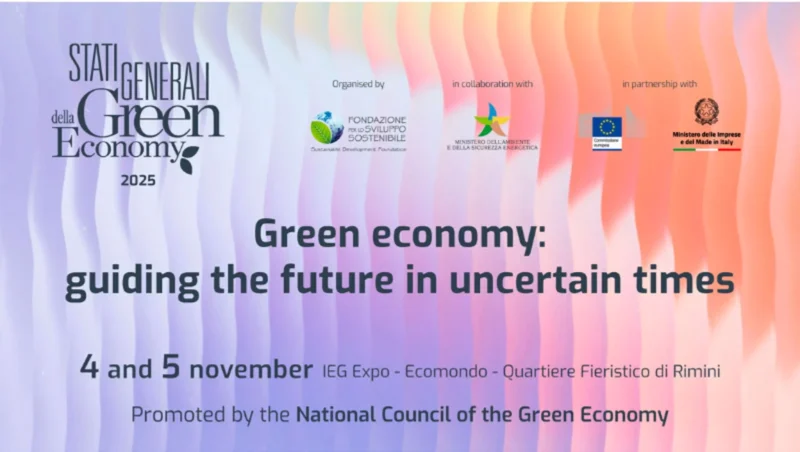
The General States of the Green Economy concluded with great success, thanks to the significant number of participants both in person and online,” the organizers of this reference event for the green, blue, and circular economy stated on Wednesday at the Exhibition Park in Rimini, Italy.
Over the course of two days, speakers from five continents analyzed global scenarios involving Europe, the United States, and China, deeming the risks of ecological regression, fueled by American policies and the reluctance of certain European governments to fully implement the ecological transition, “evident and needing to be managed.”
“This year again, in-depth discussions on ecological transition during times of crisis and conflict have generated keen interest and wide participation from the business world,” noted Edo Ronchi, president of the Sustainable Development Foundation (Italy).
“Unfortunately, at the end of these two days, we receive a bad signal from Europe,” he lamented, explaining that “while the Environment Council has formally confirmed the goal of a 90% reduction in greenhouse gas emissions by 2040, it has also sent a negative message: this dual flexibility undermines climate commitment.”
According to him, this flexibility allows for the integration of up to 5% of non-European carbon credit purchases into the carbon budget, while also permitting a maximum reduction of 5% in national climate contributions (CND).
“The climate does not wait: just like public debt, which accumulates and must later be repaid with interest, this European slowdown increases the burden,” he stated.
During this 2025 edition, the General States of the Green Economy presented their annual report, which can be viewed online at www.statigenerali.org.
The 14th edition of the General States of the Green Economy is organized by the Sustainable Development Foundation in collaboration with the Italian Ministry of the Environment and Energy Security, promoted by the National Council for the Green Economy, which consists of 66 business organizations.
The participatory process of the General States in this 28th edition of ECOMONDO, focused on analyzing perspectives, strategies, and policies of the green economy within the global debate, brought together companies, institutions, and policymakers, with the aim of developing concrete proposals for decarbonization, sustainable resource management, and urban mobility.
ECOMONDO 2025 is organized (November 4-7) with the collaboration of the European Commission, the Ministry of Enterprises and Made in Italy, the Emilia-Romagna Region, the City of Rimini, the National Association of Italian Municipalities, the National Association of the Automotive Industry, and the European Environment Agency.
MAP