



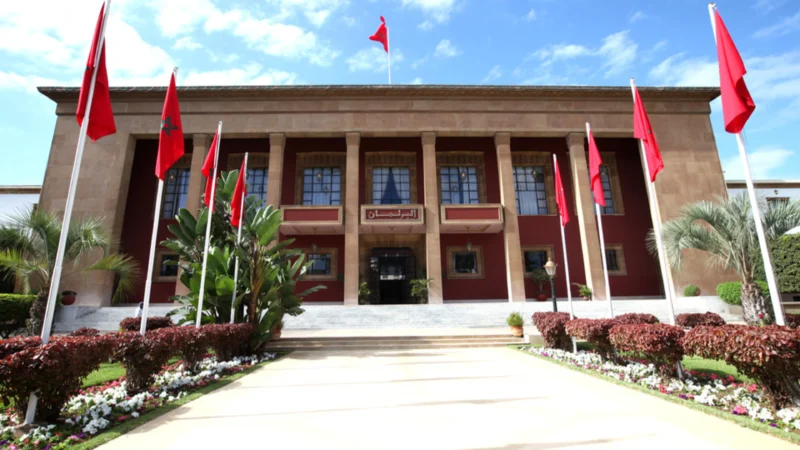
The debate on climate justice and its place in public policy has been reignited within the House of Representatives during a conference organized by the parliamentary group of the Party of Progress and Socialism (PPS), in partnership with the Moroccan Coalition for Climate Justice and several civil society organizations. Centered around the theme of strategic partnerships between Parliament and associative actors, the meeting brought together institutional leaders, elected officials, and civil society representatives to discuss climate challenges and their relationship with sustainable development.
Throughout the discussions, a common observation emerged: climate change cannot be regarded merely as an environmental issue. Its social, territorial, and economic impacts make it a fundamental concern of public action, questioning the coherence of the pursued policies, the distribution of adaptation efforts, and the effectiveness of announced commitments.
### Parliament Urged to Expand Its Role
Opening the proceedings, Rachid Hamouni, president of the PPS parliamentary group, emphasized that choosing Parliament as the venue for this meeting reflected a committed political will. He noted that climate issues require a genuine openness of the legislative institution to expertise from the ground. He advocated for moving beyond occasional consultations in favor of structured and sustainable partnerships with civil society, believing that climate justice cannot be understood without a close connection between political representation and citizen experience.
In a similar vein, Mohammed Nabil Benabdallah, secretary-general of the PPS, stressed the need to place climate issues at the core of parliamentary debate, both in law-making and in government oversight. He recalled that climate justice requires a cross-cutting approach capable of transcending sectoral logics and translating international commitments into effective public policies.
### Climate Strategy and Structural Limitations
Speaking on behalf of the Department of Sustainable Development, Bouzekri Razi presented the main orientations of the national climate strategy towards 2030, focused on adaptation, reducing greenhouse gas emissions, and strengthening capacities. While highlighting the participatory nature of the undertaken approaches, he acknowledged the existence of ongoing challenges, particularly concerning adaptation financing, intersectoral coordination, and the localization of climate policies.
Ibrahim Aaba, president of the Parliamentary Committee on Infrastructure and Sustainable Development, reminded participants that Parliament has significant constitutional levers to guide the country’s climate trajectory. He emphasized the importance of controlling and evaluating public policies, arguing that the credibility of climate commitments depends on their inscription within clear legal frameworks and sustained monitoring.
### Civil Society as a Source of Expertise
Several speakers highlighted the central role of civil society in generating analyses and proposals from the grassroots. Sanae Moussalim, representative of the Moroccan Coalition for Climate Justice, asserted that climate change is primarily a social and territorial crisis, with effects distributed unevenly. She called on institutions to fully recognize citizen expertise and integrate it into decision-making processes, beyond formal consultative mechanisms.
Debates also covered energy justice, agriculture, and water management. Abdelali Gmira, responsible for energy justice at the PPS, warned against the risks of a transition driven without consultation, which could exacerbate inequalities and undermine social cohesion. Sghir Baâli, a civil society actor, emphasized the need to rethink agricultural models in light of climate constraints, valuing local initiatives and localized approaches.
### Persistent Inequalities and Citizen Participation
The inclusion of women and youth received significant attention during the discussions. Omaïma Khalil El Fanne, representing the C4Y coalition, noted the persistent gap between constitutional principles of equality and their concrete application in climate policies. She particularly pointed out the increased vulnerability of rural women to water stress and energy poverty, as well as the still marginal participation of youth in decision-making spaces.
### Towards Structured Climate Governance
At the end of the meeting, several recommendations were made to strengthen climate governance. These included institutionalizing dialogue between Parliament and civil society, enhancing the right to access environmental information, improving the traceability of climate funding, and systematically integrating binding environmental clauses into public policies.
Participants also called for better articulation of energy transition, social justice, and democracy by incorporating issues of employment, training, and professional retraining. All these proposals aim to make climate justice not just a declarative principle but an operational framework permanently integrated into public action.