

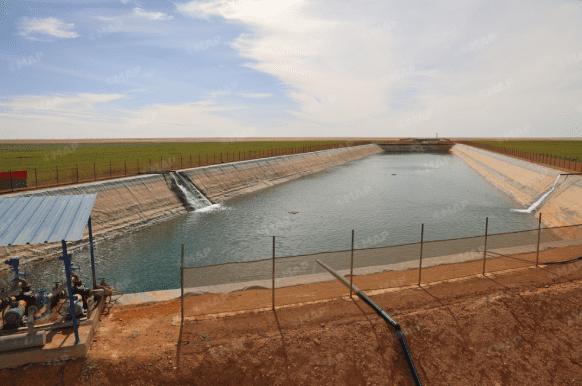
The province of Boujdour is gradually establishing itself as an emerging agricultural hub within the Southern provinces of the Kingdom, thanks to ambitious hydro-agricultural projects that reflect the success of the Moroccan model of sustainable agriculture in the Saharan regions.
In line with the new development model for the Southern provinces and the “Green Generation 2020-2030” strategy, these projects aim to enhance water resource management, strengthen milk and vegetable production, develop animal feed, and sustainably improve farmers’ incomes.
– Gueltat Zemmour: A Model of Modern and Resilient Agriculture
In Gueltat Zemmour, the Oudiyat Tious hydro-agricultural development project, covering a total area of 1,304 hectares, embodies the ambition to transform this Saharan region into a sustainable and innovative agricultural hub.
The first phase of this project involves an area of 470 hectares, including 250 hectares for silage corn production, with a total investment of 121 million dirhams.
Led by the Halib Sakia El Hamra agricultural cooperative, this project aims to optimize irrigation water use, increase milk and forage production, and boost the incomes of local farmers.
In a statement to MAP, the regional director of Agriculture for Laâyoune-Sakia El Hamra, Abderrahmane El Amri, emphasized the socio-economic significance of the project, which contributes to enhancing maize productivity through the use of modern agricultural technologies.
“This hydro-agricultural project is based on drip irrigation techniques and the use of photovoltaic panels, ensuring its sustainability and reducing production costs,” Mr. El Amri explained.
Meanwhile, the vice-president of the Halib Sakia El Hamra cooperative, Mohamed Madad, indicated that this project will achieve total forage autonomy for the cooperative, adding that it already provides job opportunities for over 52 locals.
Between 2027 and 2030, the project will be expanded by an additional 500 hectares (240 million dirhams), further solidifying its role in food security and rural job creation.
– Jrifia: A Second Thriving Agricultural Hub
At the same time, the Jrifia municipality, also part of the Boujdour province, is home to another significant hydro-agricultural development project covering a total area of 1,000 hectares, with a total investment of 465 million dirhams, of which 310 million dirhams is allocated for hydro-agricultural development and 155 million dirhams for private investment.
The first phase, already completed, covers 224 hectares across 25 projects within a public-private partnership, focusing on lands from the state’s private domain, allocated to regional investors and young entrepreneurs from Laâyoune-Sakia El Hamra.
The works included the creation and installation of eight deep wells at a depth of 1,400 meters, the setup of a photovoltaic park, construction of storage basins, establishment of a water demineralization unit, and installation of pumping, filtration, and fertigation stations.
All parcels benefit from a localized irrigation system (drip), promoting rational water use and enhanced productivity.
– Significant Production Growth and Notable Social Benefits
These projects are expected to yield significant agricultural returns: an estimated annual production of 1,750 tons of milk, 90 tons of red meat, 7,000 tons of forage crops, and 13,000 tons of vegetables.
They will contribute to optimizing groundwater resources, creating over 440 permanent jobs, and improving the living conditions of farmers by stimulating local investment.
In this context, the Ministry of Agriculture has launched a study to create an irrigated perimeter covering 8,000 hectares through seawater desalination in the Jrifia municipality.
– A Sustainable Vision for Regional Development
By focusing on modern irrigation techniques, optimizing water resources, and harnessing renewable energies, Boujdour province reaffirms its commitment to making Saharan agriculture a driver of sustainable and inclusive development.
These projects reflect the concrete realization of the royal vision of a Morocco that is cohesive, resilient, and innovative, where the Southern provinces become living laboratories for agriculture suited to arid climates, generating wealth and jobs for future generations.
MAP Ecology