

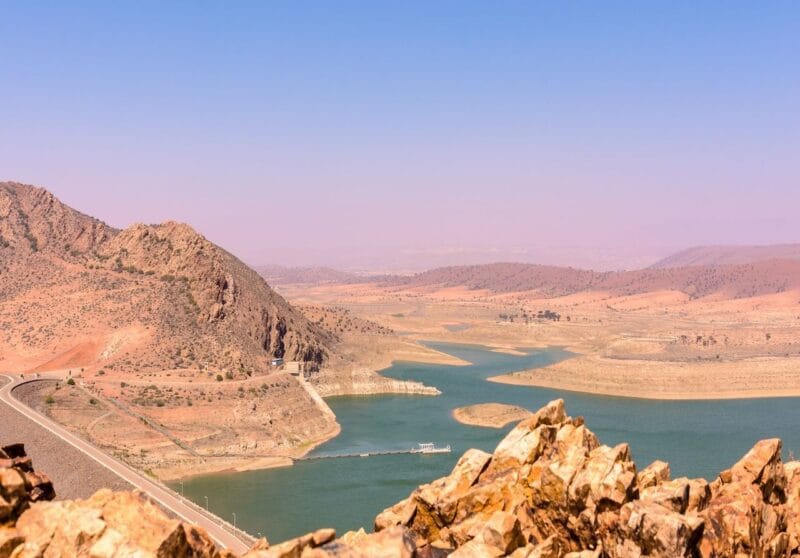
After several years marked by severe water stress, Morocco has recorded a notable increase in precipitation over the past few months, both in rainfall and snow. This improvement has allowed the Kingdom’s reservoirs to see significant progress, crossing the symbolic threshold of 50% capacity for the first time in a long while. This development fuels hope for a sustainable end to the drought. However, for climatologist Mohammed Said Karrouk, this interpretation is misleading.
According to this climate expert, the current wet episode cannot be seen as the end of the drought but rather as a temporary break in a context of high climate variability. “Morocco’s climate is structurally dry. It is dominated by the subtropical Azores high-pressure system, which historically imposes recurrent drought periods,” he explains. The return of rain observed during the current hydrological year is indeed a relief, but it does not signify a lasting change in the national climate regime.
For Karrouk, analyzing drought relies on two complementary levels. The first concerns climate indicators, such as rainfall, atmospheric circulation, or global phenomena like ENSO. The second deals with hydrological indicators, notably reservoir levels and groundwater status. “One can experience meteorological drought while still having stored water, as was the case between 2018 and 2021,” he reminds us, emphasizing that only the convergence of these two dimensions allows for a conclusion regarding the end of a drought cycle.
The current rainy episode thus falls within a context of increased climate variability. “The return of rain is real, but it does not guarantee long-term stability,” the climatologist insists. The coming months, particularly the summer and autumn periods, will be crucial in assessing whether this trend continues.
The La Niña phenomenon has, however, played a favorable role in the recent sequence. Its development allowed for an early anticipation, from autumn, of a gradual return of precipitation starting mid-November. But this effect could be temporary. Current scenarios suggest a likely end to La Niña towards the end of the hydrological year, followed by a neutral phase, during which climate uncertainty is at its highest.
In addition to this natural variability, the impact of climate change acts as an amplifier of extremes. “It does not create cycles, but it intensifies them,” summarizes Karrouk. Droughts are becoming longer and more severe due to rising temperatures and increased evaporation. Conversely, when rain does occur, it is often more intense, concentrated in time and space, raising the risks of flooding.
From a water perspective, the situation remains concerning. Recent precipitation has not sustainably replenished certain strategic reserves. Major reservoirs, such as Al Massira, are still showing very low filling rates. As for aquifers, especially in the Tadla, Tensift, or Souss regions, they remain heavily stressed and recharge slowly, partly due to soil degradation that limits infiltration.
The climatologist also warns against potential political over-interpretation of the current calm. A relaxation of water management policies, particularly in the agricultural sector, would, according to him, constitute a major mistake. He argues instead for a structural and sustainable adaptation of water usage, based on regulation, anticipation, and aligning public policies with the country’s hydric reality.
In the medium term, several scenarios remain possible: a tightening of drought conditions due to the strengthening of the subtropical high-pressure system, an alternation of extreme rainfall episodes and long dry periods, or an unstable combination of both. In light of these uncertainties, Mohammed Said Karrouk believes that Morocco must prepare for the worst to secure its water resources, focusing on hydraulic transfers, controlled desalination, reducing evaporation losses, and, above all, agriculture fully adapted to the climatic constraints of the Kingdom.