

Morocco now acknowledges a harsh reality: water pressure is no longer a temporary issue. The decline in rainfall, the exhaustion of aquifers, and rising demands compel the country to reorganize its water supply sources. The directive is clear: produce more water, enhance the distribution of available supply, and reduce losses.
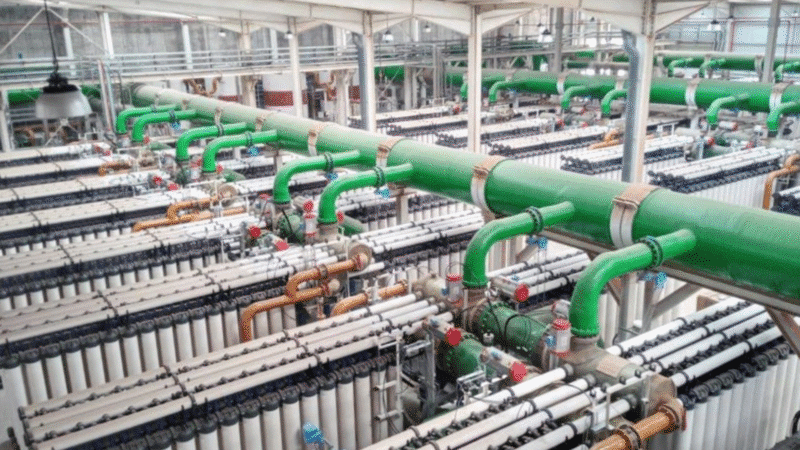
The rise of desalination is the most visible pillar of this transformation. The country currently has 17 operational plants capable of generating nearly 350 million cubic meters per year. Ongoing projects are set to elevate Morocco to a new level: by 2030, total capacity is expected to reach approximately 1.7 billion cubic meters, accounting for nearly 60% of national potable water needs. The units under construction will rely on renewable energy to mitigate operational costs and ensure continuous operation.
This initiative is accompanied by another strategic focus: water interconnection. The goal is straightforward: to circulate water between surplus regions and deficit areas to secure supply for urban centers as well as agricultural territories dependent on local rainfall. This network aims to make the national system less vulnerable to regional precipitation variations.
Simultaneously, the reuse of treated wastewater is changing its scope. Once limited to green spaces, its application now extends to agricultural and industrial uses. Morocco plans to multiply these volumes to alleviate deep aquifers, particularly in regions where over-extraction has become critical.
It is precisely on these aquifers that a turning point is occurring. “Aquifer contracts” now set extraction quotas negotiated with users. Five contracts are active, with nineteen others in the planning stages. These pertain to regions such as Souss, Haouz, Doukkala, and the Southeast, all marked by concerning declines in groundwater levels.
On the ground, the use of resources is also evolving. Agriculture is gradually transitioning to precision irrigation through sensors, climate monitoring, and the optimization of drip systems. In cities, networks are being modernized with smart meters capable of quickly detecting leaks, a significant source of technical loss reduction.
Natural loss reduction is also becoming a field of innovation. In some areas, evaporation from reservoirs exceeds 30%. Floating solar panels are being tested on several dams to protect water surfaces while generating clean energy for pumping and desalination.
The country is also modernizing its cloud seeding program, “Al Ghait.” This approach now relies on artificial intelligence and more precise atmospheric mapping. This device is not a substitute for desalination or dams, but an additional support during periods of drought, particularly in mountainous and irrigated zones.
Finally, experiments are emerging in water production from atmospheric humidity, utilizing devices powered by solar energy. Concurrently, a more anticipatory meteorological monitoring system has been implemented to incorporate expected climate impacts into water management decisions.
One certainty is emerging: scarcity will not be bypassed but managed. Morocco is no longer waiting for rain; it is building a sustainable water architecture based on source diversification, usage discipline, and technology. This transition marks a shift from emergency management to a permanent water security strategy.
With Le360