

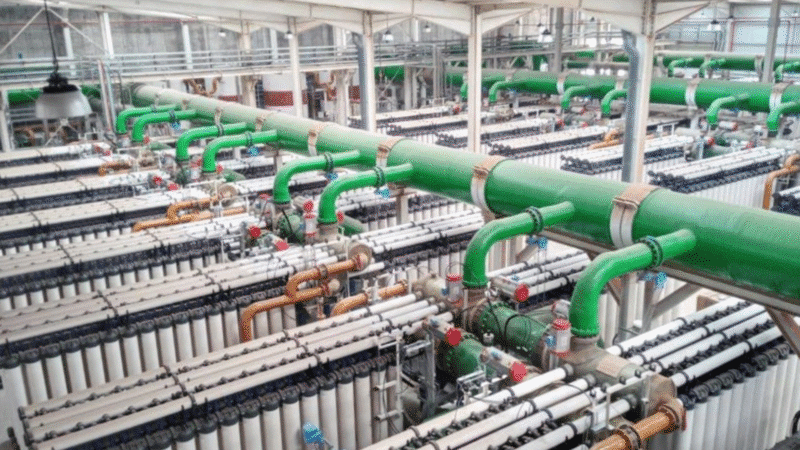
Morocco is continuing the development of its seawater desalination infrastructure to enhance its water security. Four new stations, with a total capacity of 567 million cubic meters per year, are currently under construction and are expected to be operational by the end of the year, according to the Minister of Equipment and Water, Nizar Baraka.
This project is part of a national desalination program launched in line with the directives of King Mohammed VI. The goal is to secure the supply of drinking water for coastal cities and some inland areas, while also supporting agricultural irrigation and industrial requirements.
By 2030, authorities aim for a total production capacity of desalinated water of 1.7 billion cubic meters per year.
Currently, 17 desalination stations are already operational in Morocco, with a combined capacity of approximately 350 million cubic meters per year.
Among the new infrastructures under construction are the stations in El Jadida and Safi, where significant progress has been made. Partial operation has already begun in 2023, while full capacity is expected to be reached by the end of 2026. The Jorf Lasfar station is already contributing to the water supply of several areas, including southern Casablanca, Settat, and Berrechid.
The program also includes the Dakhla station, which is about 78% complete. This facility will be partially powered by a wind energy production unit and is expected to be operational by mid-2026.
Another major project is the Casablanca station, set to become the largest desalination plant in Africa, with a total capacity of 300 million cubic meters per year. The construction is currently showing nearly 50% progress, while the first phase of 200 million cubic meters is expected to be operational by the end of 2026.
These projects mainly rely on public-private partnerships, a model that allows for the mobilization of specialized technical skills while sharing investments and financial risks.
Additionally, eleven new desalination projects are planned in various coastal regions of the country. Stations are specifically anticipated in the Oriental, Tangier, Rabat, Essaouira, and Guelmim, while studies related to the Souss-Massa project are still ongoing.
The ministry is also collaborating with the OCP Group to develop complementary projects, including the expansion of the El Jadida and Safi stations, in order to strengthen the supply of drinking water and meet industrial needs.
In addition to the large stations, a program is underway to install mobile desalination stations aimed at treating seawater or brackish groundwater, particularly in rural areas. A total of 244 mobile units are set to be deployed, with an overall capacity of 1,563 liters per second.
To date, 124 mobile stations have already been delivered, representing a capacity of 771 liters per second. Among these, 77 units, capable of producing 514 liters per second, are currently being installed, while the final units are expected to be operational during the year.
All of these projects aim to sustainably transform water management in Morocco. By combining large desalination plants, industrial expansions, and mobile units, the country seeks to develop unconventional water production capable of meeting the increasing pressure on natural resources, while supporting the supply to cities, agricultural irrigation, and industrial needs in an increasingly challenging climate context.