



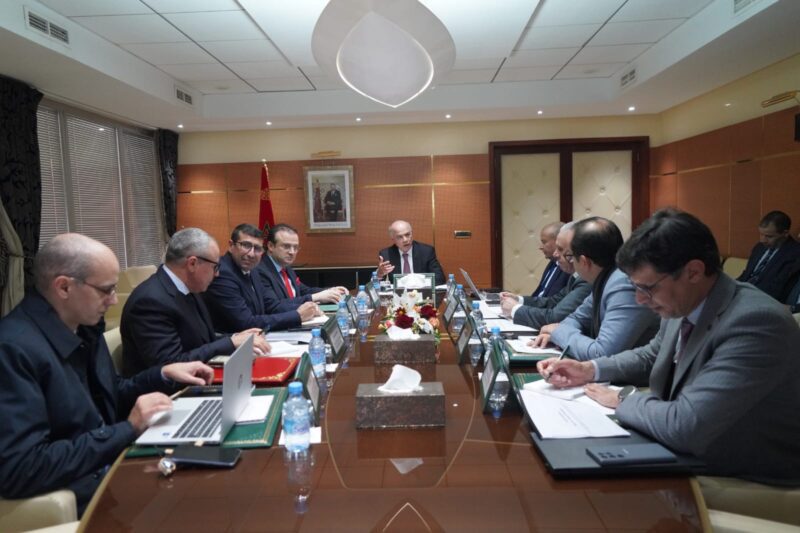
In response to the rising tensions over natural resources and the combined challenges of climate change, energy transition, and food security, the High Commission for Planning (HCP) has embarked on a new phase in national strategic reflection. Meeting in Rabat, the steering committee officially launched a prospective study on the Water–Energy–Food Nexus (WEF) looking towards 2040, in partnership with several key governmental departments and public institutions.
This initiative brings together, alongside the HCP, the Ministry of the Interior, the Ministry of Economy and Finance, the Ministry of Equipment and Water, the Ministry of Agriculture, Maritime Fisheries, Rural Development, and Water and Forests, the Ministry of Energy Transition and Sustainable Development, as well as Bank Al-Maghrib. This unprecedented institutional alliance aims to go beyond traditional sectoral approaches and jointly analyze the interdependencies between three vital resources for the country.
The study aligns with the High Royal Guidelines calling for enhanced coherence in public policies and embodies the spirit of the New Development Model, which advocates for a systemic approach to public action. The objective is clear: to illuminate long-term choices and enhance the State’s capacity to anticipate risks and arbitrate more effectively.
Thinking Together About Interconnected Resources
Water, energy, and food are essential pillars of daily life for Moroccans and national resilience. Decisions made in one of these domains have direct repercussions on the others. An energy choice can increase pressure on water resources, while an agricultural direction influences food security, water consumption, and energy demand.
In this context, the HCP believes it is no longer feasible to conceive public policies in silos. The so-called “Nexus” approach aims precisely to understand and quantify these interactions in order to anticipate their economic, social, and territorial effects in the long term.
A Prospective Approach to Support Public Decision-Making
Designed using a rigorous methodology, the study combines qualitative and quantitative analyses, strategic foresight, and economic and environmental modeling. It will allow for the development of several contrasting scenarios for 2040, measuring their impacts and identifying possible trajectories for sustainable resource management.
Beyond projections, the approach aims to highlight the synergies and tensions between water, energy, and food policies, while linking these choices to their tangible consequences on growth, employment, household purchasing power, social well-being, and macroeconomic balances.
A Directly Citizen-Centered Challenge
Conducted in close consultation with the relevant administrations, as well as experts, operators, and civil society representatives, this study serves as a genuine tool for strategic decision-making. Its ambition exceeds the technical framework: it fundamentally aims to secure citizens’ access to vital resources, enhance the country’s resilience to climate and economic shocks, and reduce social and territorial inequalities.
By placing integrated management of the Water–Energy–Food Nexus at the heart of national foresight, the HCP seeks to contribute to more coherent and clearer public action. This approach aims to equip the State with an enhanced capacity for anticipation and arbitration, based on data, impact analysis, and the public interest, to prepare today for the structuring choices of tomorrow.