
Close Menu
Greentimes
    Qoui de neuf

    Solar Energy: The Chinese Group Lanke High-Tech Prepares to Establish Operations in Morocco and Develops a 100 MW Thermal Storage Project

    12 March 2026

    Morocco is accelerating desalination with four new stations and aims for 1.7 billion cubic meters of water per year by 2030.

    12 March 2026

    Green Hydrogen: Moroccan Ports Could Become a Strategic Hub for Decarbonized Maritime Transport

    12 March 2026
    Facebook X (Twitter) Instagram
    GreentimesGreentimes
    • Home
    • CSR
    • Energy Transition and Renewables
    • Sustainability
    • Climate Change
    • Analyses and Opinions
    • Datas
    • Dates & events
    • Last news
    • FR
    Thursday 12 March 2026
    Facebook X (Twitter) Instagram
    Greentimes
    Home » Smartphones and tablets: a new mandatory energy label in the European Union
    Sustainability

    Smartphones and tablets: a new mandatory energy label in the European Union

    21 June 2025No Comments2 Mins Read
    Facebook Twitter Pinterest LinkedIn Tumblr Reddit WhatsApp Email
    Share
    Facebook Twitter LinkedIn Pinterest WhatsApp Email

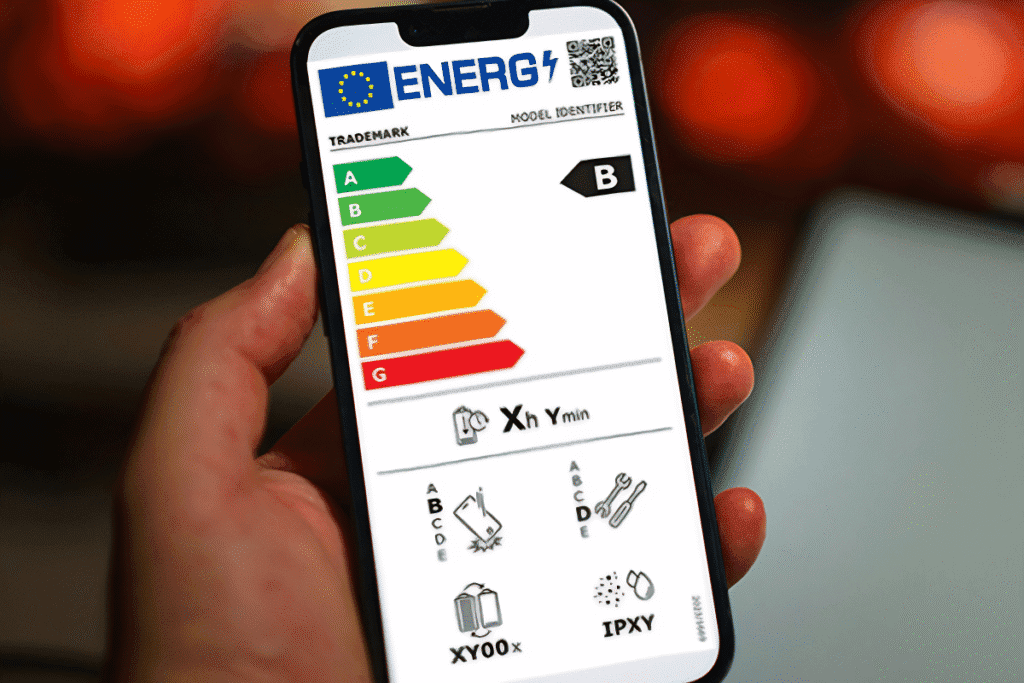
    Since June 20, 2025, smartphones and tablets sold in EU member countries must now display an energy label. This new labeling, similar to that already in place for household appliances, aims to guide consumers towards more sustainable purchases by highlighting energy performance, durability, repairability, and resistance of devices.

    This measure is part of the European Green Deal and the EU’s ecological transition strategy. The label takes the form of a color code ranging from A (best performance) to G (lowest performance), accompanied by practical information: battery life, shock resistance, estimated lifespan, ease of repair, and water and dust resistance. The stated goals are twofold: to extend the lifespan of electronic devices and to reduce the environmental footprint associated with their production and disposal.

    This harmonized labeling system at the European level replaces national initiatives, such as the repairability index in France, which has so far been limited to a few types of products. It aims to generate, by 2030, 20 billion euros in savings for European households and 2 terawatt-hours of electricity saved, equivalent to the consumption of one million French households.

    However, some associations like Stop Planned Obsolescence lament that the cost of repairs is not included in the evaluation criteria. Other criticisms focus on the complexity of reading the label or the excessive emphasis placed on energy consumption, while the production of a smartphone concentrates the majority of its ecological impact due to the extraction of rare metals like lithium or palladium.

    Despite these limitations, this measure marks an important step towards more responsible consumption at a time when the market for new smartphones is clearly slowing down: in 2024, 13 million devices were sold in France, compared to 20 million ten years earlier. The new system could thus encourage more consumers to prioritize repairability, longevity, and sustainability in their digital purchasing choices.

    Energy Label mandatory Smartphones tablets:
    Previous ArticleTétouan: a new project to secure the supply of drinking water.
    Next Article Koudia Al Baida: Morocco reinvents wind energy by doubling the power with half the number of turbines.

    Related Posts

    Morocco is accelerating desalination with four new stations and aims for 1.7 billion cubic meters of water per year by 2030.

    12 March 2026

    Energy Transition: Morocco, “a Strategic Partner” for the European Industry (IEG)

    12 March 2026

    Urban Planning: Ms. El Mansouri Calls for Establishing Water Resilience as a National Standard

    11 March 2026
    Leave A Reply Cancel Reply

    Ne ratez pas
    Energy Transition and Renewables

    Solar Energy: The Chinese Group Lanke High-Tech Prepares to Establish Operations in Morocco and Develops a 100 MW Thermal Storage Project

    12 March 20260

    Chinese company Lanke High-Tech, specializing in energy equipment and solar thermal storage technologies, has announced…

    Morocco is accelerating desalination with four new stations and aims for 1.7 billion cubic meters of water per year by 2030.

    12 March 2026

    Green Hydrogen: Moroccan Ports Could Become a Strategic Hub for Decarbonized Maritime Transport

    12 March 2026

    Energy Transition: Morocco, “a Strategic Partner” for the European Industry (IEG)

    12 March 2026
    Restez connecté
    • Facebook
    • Twitter
    • Pinterest
    • Instagram
    • YouTube
    • Vimeo
    Nos vidéos

    The circular economy at the heart of LabelVie group’s initiatives.

    10 July 2025

    Mounir El Bari: “Our great ecological challenge is access to the resource!”

    10 July 2025

    Driss Nahya: “Control must be strengthened to access the waste deposit.”

    10 July 2025

    Reda Boukallal: “Priority to the valorization of household waste”

    10 July 2025
    Facebook X (Twitter) Instagram Pinterest
     
    © 2026 Green Times.

    Type above and press Enter to search. Press Esc to cancel.