

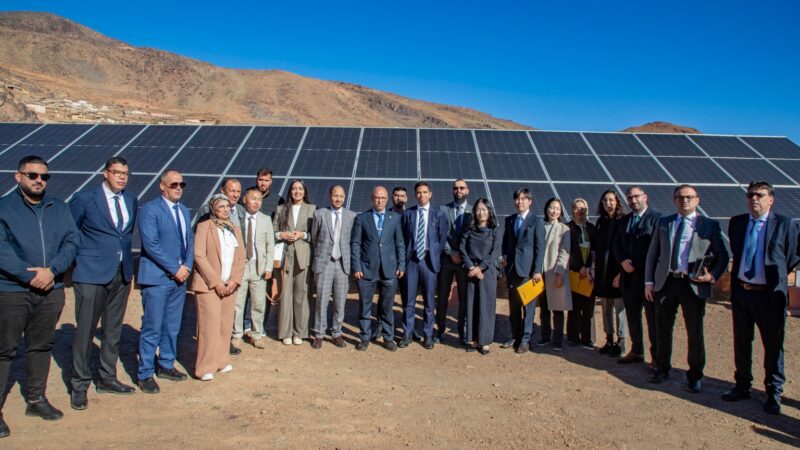
The development of renewable energy continues to play a key role in improving electricity access in Morocco. The Chinese group Jinko Solar has recently participated in the commissioning of several photovoltaic mini-grids intended to provide solar energy to remote regions of the Kingdom, thus contributing to the electrification of areas far from the national grid.
Jinko Solar’s involvement was marked by its presence at the closing ceremony celebrating the completion of these installations. On this occasion, the company reaffirmed its commitment to providing sustainable, reliable, and secure energy access, emphasizing that its efforts go beyond supplying photovoltaic technologies and are part of a broader vision to support local communities.
The mini-grids aim to meet the essential energy needs of populations living in isolated areas where connection to the national electricity grid remains complex or economically burdensome. According to Jinko Solar, these infrastructures represent “a decisive step” in ensuring continuous access to electricity, which is essential for the functioning of community services and improving living conditions.
### Photovoltaic Technologies Suitable for Remote Areas
As part of this project, the Chinese group reported contributing by donating state-of-the-art photovoltaic modules, specifically the Tiger Neo panels, based on N-type technology. These devices are described as offering high efficiency, improved durability, and increased resistance to weather conditions, characteristics deemed crucial for ensuring the stability of electricity supply in isolated environments.
The integration of these modules within the mini-grids would ensure a clean and reliable electricity production, catering not only to basic domestic uses but also to the needs of schools, health centers, and other local infrastructures.
### Institutional Cooperation for Energy Transition
The ceremony was held under the auspices of the Moroccan Agency for Sustainable Energy (Masen), in the presence of representatives from the Ministry of Energy Transition and Sustainable Development, the Korean International Cooperation Agency (KOICA), and local authorities. Speakers highlighted the significance of this initiative, presented as a concrete example of cooperation among public institutions, international partners, and stakeholders in the renewable energy sector.
This collaboration aligns with Morocco’s energy trajectory, which aims to strengthen universal access to electricity while accelerating the deployment of clean energies. In this context, solar mini-grids emerge as a complementary solution to the national grid, particularly suitable for remote territories.
For Jinko Solar, this participation reflects a desire to accompany local energy transitions and contribute to more resilient and environmentally respectful development models. This approach is part of a broader dynamic of international cooperation focusing on energy access issues and combating climate change.