

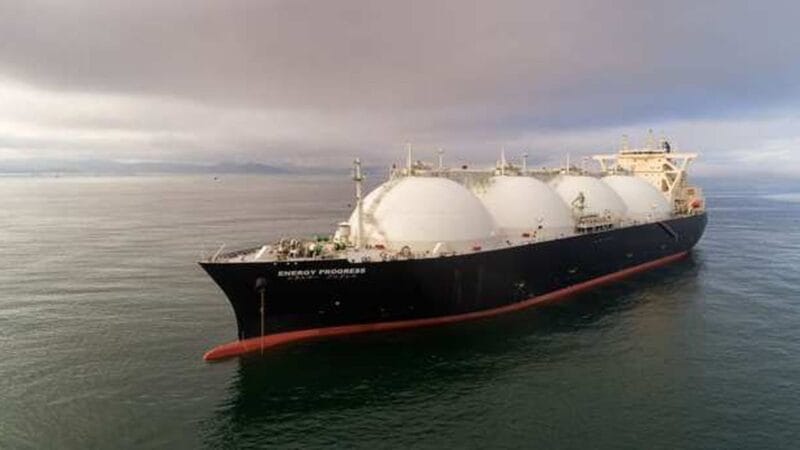
In light of a still massive energy dependency, Morocco is accelerating its transition towards a greener and more sovereign economy. At the heart of this strategy is liquefied natural gas (LNG), considered a transitional energy source capable of providing flexibility, industrial competitiveness, and security of supply.
### From Fuel Oil to Gas: A Strategic Shift
Today, nearly 94% of the energy consumed in Morocco is imported, a disparity that cost the state 114 billion dirhams in 2024. In response to this colossal bill, the Kingdom is pursuing a dual approach: to expedite the growth of renewable energies—already accounting for 45% of the electricity mix—and to develop a robust national gas sector.
“Every point of fossil fuel replaced by renewables represents a savings of about 2 billion dirhams per year,” explains economist Abdelghani Youmi, as quoted by Finances News Hebdo. But beyond solar and wind, liquefied natural gas emerges as the missing link: a cleaner energy source than coal, capable of ensuring the stability of the electrical grid and supporting industrial growth.
### An Ambitious Roadmap by 2050
Morocco is implementing a structured gas strategy, centered around several flagship projects:
– The first LNG station at Nador West Med, announced by Nadia Fettah, Minister of Economy and Finance.
– Two new gas-powered units at Tahaddart.
– The gradual conversion of thermal power plants that operate on fuel oil or coal.
The goal is to make gas a vector of flexibility to support the integration of intermittent energies while enhancing supply security.
### The Nigeria-Morocco Pipeline: Backbone of a Future Energy Hub
Symbolizing this ambition, the Nigeria-Morocco Gas Pipeline (NMGP) presents itself as a continental project with high potential for regional integration. Stretching thousands of kilometers and estimated to cost between 20 and 25 billion dollars, it will connect Nigeria’s gas reserves to European markets via Morocco.
According to BMCE Capital Global Research, this megaproject could generate up to 1.5 billion dollars in annual savings on the Kingdom’s energy bill and stimulate GDP growth by 0.5 to 1% per year during its construction phase. The launch of the Nador-Dakhla section’s construction, announced by Energy Transition Minister Leila Benali, marks a decisive step.
### Modern Infrastructures and Local Resources
To bolster its autonomy, Morocco is also preparing to commission a floating storage and regasification unit (FSRU) at Jorf Lasfar by 2026-2027, with a capacity of 1.5 to 2 billion cubic meters per year. This facility will allow the country to import gas directly, bypassing the Iberian network.
At Nador West Med, a signed contract with Shell already guarantees the supply of 500 million cubic meters per year, with an extension planned to reach 1,500 MW by 2028. Concurrently, the future Al Wahda gas power plant (990 MW) in the province of Ouazzane will enhance the national grid’s security.
Regarding local resources, the Tendrara and Anchois (Larache) projects open promising prospects: the former expects 350 million cubic meters per year, while the latter holds more than 13 billion cubic meters of recoverable gas.
### A Lever for Industrial Competitiveness
Access to reliable and competitive gas could transform the Moroccan industrial landscape. Energy-intensive sectors—such as cement, fertilizers, metallurgy, chemicals, and phosphates—will benefit from a more stable and lower-cost energy supply, promoting the relocation of certain productions and boosting exports.
According to projections, the rise of gas and the NMGP could support a cumulative GDP growth of 5 to 8% between 2025 and 2040.