

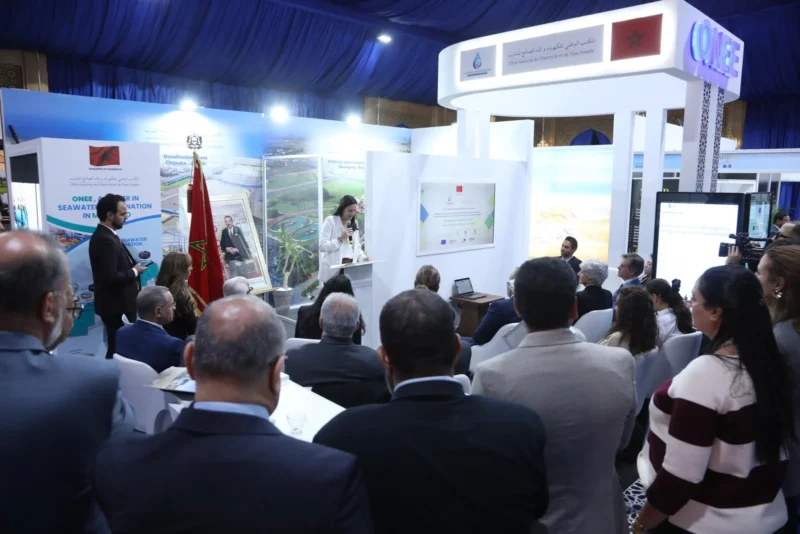
A workshop focused on presenting the National Program for Shared Liquid Sanitation and Treated Wastewater Reuse (PNAM) was held on Monday in Marrakech alongside the 19th World Water Congress.
Initiated by the National Office of Electricity and Drinking Water (ONEE), this workshop served as an opportunity to highlight the results of the program, established by the office with the financial support of various partners, including the European Union, the European Investment Bank, the French Development Agency, the German Development Bank, and Belgian Cooperation.
Created in 2005 under the name “National Liquid Sanitation Program” and rebranded as PNAM in 2018, this program aims to achieve a connection rate of 95% and a pollution treatment rate of 80% in urban areas by 2040, equip 1,200 municipality capitals in rural areas, and reuse 573 million cubic meters per year.
Speaking on this occasion, ONEE Director General Tarik Hamane emphasized that the results of this vital sanitation program have significantly contributed to environmental protection, local socio-economic development, and the improvement of the quality of life for beneficiary populations.
An essential success factor of PNAM has been the establishment, for the first time, of an inclusive communication strategy to support the realization of numerous projects while considering gender approaches, Mr. Hamane continued, noting that this initiative arose from the need to provide innovative solutions to the challenges and issues surrounding community engagement in liquid sanitation projects.
For her part, the Director of AFD in Morocco, Catherine Bonnaud, pointed out that this program, designed to reduce pollutant discharges, strengthen the resilience of natural environments, and preserve water resources, has enabled significant investments in about thirty urban centers.
PNAM has also allowed for the sustainable improvement of living conditions in numerous municipalities by modernizing essential infrastructure and enhancing the capacity of stakeholders to operate and maintain them, she noted, praising “the decisive contribution of the Kingdom, which reflects the priority given to territories and their development, particularly in these complex issues of sanitation, social challenges, and environmental and public health concerns.”
Under the High Patronage of His Majesty King Mohammed VI, the World Water Congress, co-organized until December 5 by the Ministry of Equipment and Water and the International Water Resources Association (IWRA), presents an opportunity to explore innovative solutions, strategies, and adaptive approaches for water resources in a constantly changing world.
The program for this 19th edition includes a ministerial roundtable, four high-level panels, over 140 technical sessions led by international experts, parallel events to delve deeper into specialized topics, and a vast exhibition space dedicated to showcasing innovative water technologies and projects.
The proceedings of this major event will culminate in the “Marrakech Declaration,” a collective call uniting decision-makers, scientists, and practitioners to strengthen the connection between science, policy, and action, and to accelerate global mobilization for water preservation.
MAP