






In Marrakech, where the city’s history is closely tied to water, the 19th World Water Congress opened its session with an unequivocal observation: international commitments related to Sustainable Development Goal 6 are significantly lagging behind. Ministers, UN representatives, leaders of international organizations, and experts emphasized the urgency for profound change, asserting that only a combination of technological innovations and ambitious political decisions can avert an irreversible global crisis.
A Multidimensional Crisis Becomes Reality
At the inaugural session, Yuanyuan Li, president of the International Water Resources Association, reminded participants of the magnitude of the challenges. According to him, climate and socio-economic pressures make the situation more critical today than it was three decades ago. Water, he noted, is not merely a resource but a constitutive element of societal identity and a vital factor for survival.
This reality is reflected in the contradictions highlighted by the UN’s Special Envoy for Water, Retno L. P. Marsudi. She cited the example of an Indonesian village where access to drinking water requires hours of walking each day. Such examples illustrate that while technical solutions exist, their deployment depends on better coordination, appropriate skills, and accountable political choices. For her, water must be integrated across climate, biodiversity, and peace agendas.
The Moroccan Experience: A Transition Focused on Production
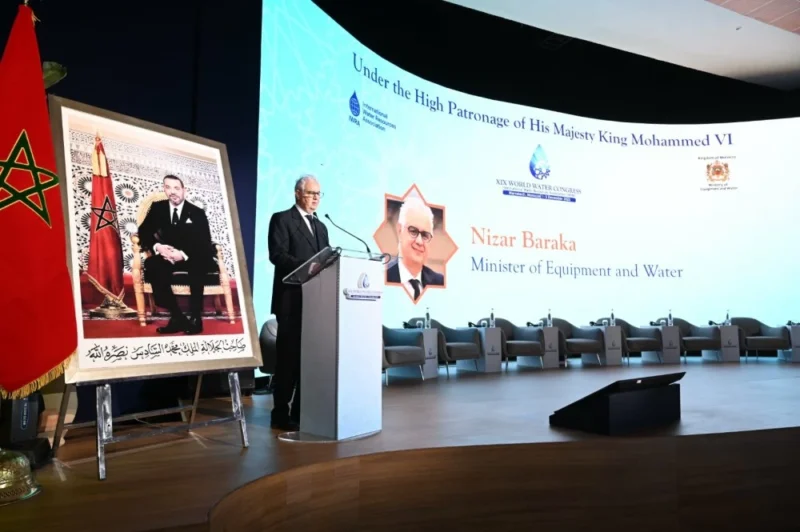
In response to this global situation, Morocco has presented a structured strategy centered on a major objective: ensuring its water sovereignty. Nizar Baraka, the Minister of Equipment and Water, explained that the country has shifted from deficit management to a model aimed at increasing water production.
This transformation relies on several complementary levers:
- Massive use of desalination, with a target of 1.7 billion cubic meters of capacity by 2030, powered by renewable energy.
- Integration of advanced technologies, including artificial intelligence to detect leaks via smart meters in urban areas.
- Innovative solutions, such as floating solar panels over dams to reduce evaporation and produce necessary energy.
- Establishment of the “Water–Renewable Energy–Food Nexus”, supported by aquifer contracts imposing controlled use of groundwater.
Water Sobriety: An Essential Pillar
While technology occupies a central role, speakers stressed the need to couple production with a transformation of usage. Loïc Fauchon, president of the World Water Council, advocated for a balanced approach that includes stricter demand management. He reminded attendees that water sobriety is an essential part of progress, especially in water-intensive sectors like industry and data centers.
He also drew attention to the long-neglected issue of sanitation, calling for a true resurgence and international mobilization. He announced the creation of an International Center dedicated to unconventional water associated with renewable energy, which will be established in Morocco.
Political Will: The Cornerstone of Success
Beyond technologies and behavioral changes, the UN stressed the crucial role of political decisions. Retno Marsudi urged participants to take responsibility to prevent the current era from becoming one “that had the evidence but failed to act.” Water, several speakers reiterated, is a fundamental link between peoples, generations, and development goals.
This edition will mark a turning point, as it calls for renewed commitment to make water a vehicle for shared prosperity.
A Historic Return to Morocco After Rabat 1991
Organized from December 1 to 5, 2025, under the High Patronage of His Majesty King Mohammed VI, the Marrakech Congress brings together researchers, policymakers, international organizations, private sector actors, and civil society representatives around the theme “Water in a Changing World: Innovation and Adaptation.” The event is part of a global dynamic linking water to the challenges of energy, food, health, and ecosystem preservation.
It also connects with major upcoming international events, including the UN Water Conference 2026, the World Water Forum 2027, and future COPs on climate and biodiversity. More than thirty years after Rabat 1991, this new edition extends Morocco’s commitment to sustainable water resource management and contributes to the global debate on adaptation in the face of increasing water pressures.


