

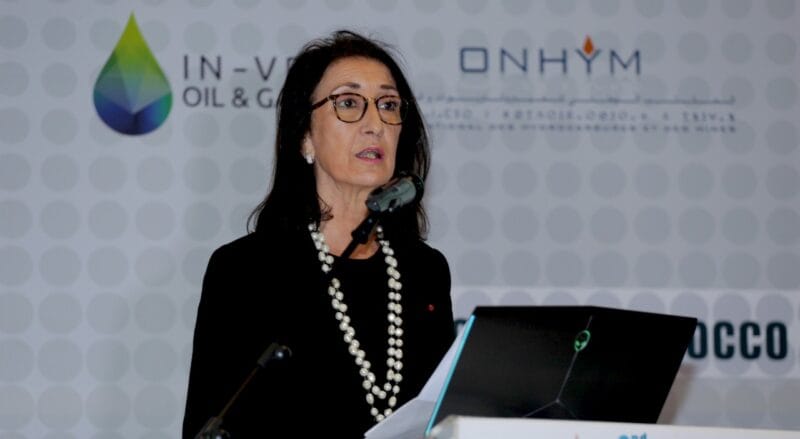
Long confined to the exploration of hydrocarbons and mineral resources, the National Office of Hydrocarbons and Mines (ONHYM) is undergoing a significant strategic repositioning. Under the leadership of its Director General, Amina Benkhadra, the institution is now expanding its scope to encompass key functions of the energy transition: strategic gas storage, hydrogen preparation, and CO₂ capture and storage, while consolidating its midstream activities and international partnerships. This evolution positions Morocco’s subsurface as a central lever for energy security, industrial decarbonization, and territorial development.
At the heart of this transformation is a national study launched in September 2025 on the potential for geological storage of natural gas, hydrogen, and CO₂. The objective is clear: to equip Morocco with a structural capacity for energy security. “This is about preparing the country both for the management of current gas flows and for future low-carbon energy vectors,” explains Amina Benkhadra.
Initially, ONHYM prioritizes strategic gas storage, anchored in three major projects: the conversion and optimization of the Maghreb-Europe Gas Pipeline (GME), the Atlantic African Gas Pipeline, and the LNG terminal at Nador. In the medium term, this approach will evolve towards multiproduct energy hubs capable of integrating hydrogen storage and, ultimately, CO₂ sequestration solutions to support industrial decarbonization.
This ambition is supported by a targeted strengthening of international partnerships. In October 2025, ONHYM signed two strategic protocols with Fujairah Natural Resources Corporation and Fujairah Oil Industry Zone in the United Arab Emirates. These agreements aim to accelerate Morocco’s positioning in strategic minerals, energy logistics, and Earth sciences.
Cooperation with FNRC focuses on the exchange of geological data, advanced mapping, and geophysics, while the partnership with FOIZ concerns the structuring of energy industrial zones and the development of storage hubs. For ONHYM, this involves aligning with players who have proven expertise in managing large-scale energy infrastructures.
The midstream subsidiary, OMCo, the midstream arm of ONHYM, is playing an increasingly strategic role. It is already managing the GME pipeline and is preparing to oversee future transport and transit infrastructures related to national gas projects. Interconnection with consumption centers, particularly ONEE’s power plants, and the development of new connections are among the priorities.
This strengthening is accompanied by strict international standards in risk management, maintenance, and economic models to ensure the financial sustainability of infrastructures. In a regional context marked by energy uncertainty, the midstream sector becomes a key factor for resilience.
In terms of exploration, Morocco retains significant advantages. The Gharb basin, the site of North Africa’s first gas discovery, remains attractive due to profitable deposits and an existing network of gas pipelines. The Essaouira basin continues to supply industrial facilities, notably those of OCP, while Tendrara is establishing itself as a major gas hub with a Micro-LNG project expected in 2026.
Meanwhile, several onshore basins and offshore areas, from north to south across the Kingdom, are subject to projects conducted with international partners such as Chariot Oil & Gas, Exxon Mobil, Hunt Oil, and NewMed/Adarco, enhancing Morocco’s visibility on the regional energy map.
Beyond hydrocarbons, ONHYM is clearly positioning its actions within a low-carbon trajectory. Geological energy storage and CO₂ capture are presented as a logical extension of its historical expertise. A gradual investment pathway for the period 2025–2030 has been defined, incorporating studies, pilot projects, and public-private partnerships.
This approach aims to make Morocco’s subsurface an active tool for the energy transition, capable of supporting industrialization while reducing the carbon footprint of heavy industries.
The economic and social impact remains a central focus. Each ONHYM project includes a local development component: employment, training, infrastructure, and reliance on regional businesses. According to Amina Benkhadra, “every dirham invested by ONHYM generates an average of ten dirhams in partner investments,” creating a ripple effect across territories.
Finally, Morocco is asserting itself as a driving force in African mineral governance. The Marrakech Declaration, adopted at the IMC Morocco 2025, lays the groundwork for a unified ESG framework for critical minerals. This vision holds that the mineral sovereignty of the continent requires high standards and the construction of local industrial value chains, beyond the export of raw materials.
Through this strategy, ONHYM is no longer content to explore the subsurface; it is making it a foundational pillar of energy security, the low-carbon transition, and Morocco’s economic development.