

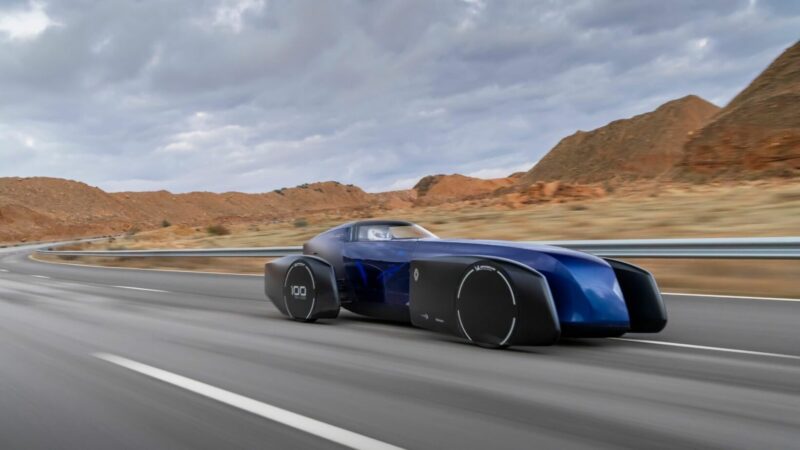
Renault achieved an unparalleled feat in the field of electric mobility on December 18. At the UTAC circuit in Morocco, the prototype Renault Filante Record 2025 covered 1,008 kilometers in under ten hours, without any intermediate charging, setting a new efficiency record for an electric vehicle.
Equipped with an 87 kWh battery, identical to that of the series production Scenic E-Tech electric, the demonstrator maintained an average speed of 102 km/h, with an exceptionally low consumption of 7.8 kWh per 100 kilometers. Three drivers took turns to complete this achievement, which was executed under conditions similar to highway usage.
A Mobile Laboratory Dedicated to Efficiency
Launched at the beginning of the year, this project aimed to demonstrate that a range exceeding 1,000 kilometers could be achieved without resorting to an exceptionally large battery. To achieve this, engineering teams focused their efforts on three major areas: aerodynamic optimization, weight reduction, and the integration of innovative materials.
Initial wind tunnel tests revealed an excessively high aerodynamic drag. “We had to thoroughly revise the wheel fairings and simplify the airflow around the mechanical components,” explains Jocelyn Mérigeault, aerodynamic engineer at Renault. Directly attaching the fairings to the wheels and drastically reducing air inlets and outlets significantly lowered parasitic drag.
According to the engineer, the Filante Record had a strong aerodynamic potential from its design phase. “Our work consisted of revealing this potential while respecting the visual identity of the model, balancing heritage and technical performance,” he notes.
Between Heritage and Innovation
The design of the prototype is directly inspired by Renault’s iconic models, particularly the 40 CV from the records of 1925 and the Étoile Filante from 1956, borrowing elements from the aviation world and Formula 1. Its streamlined silhouette and closed cockpit enhance its image as a mobile laboratory, primarily conceived as a tool for technological experimentation.
Beyond the sporting and symbolic performance, Renault emphasizes that the lessons learned from this project will inform the development of its future series electric models. The stated goal is to improve the overall efficiency of vehicles, thereby offering higher ranges suited for daily use, including on highways.
With this record set in Morocco, the French manufacturer reaffirms its ambition to remain a central player in innovation within electric mobility, blending historical expertise with cutting-edge technologies aimed at the future.