

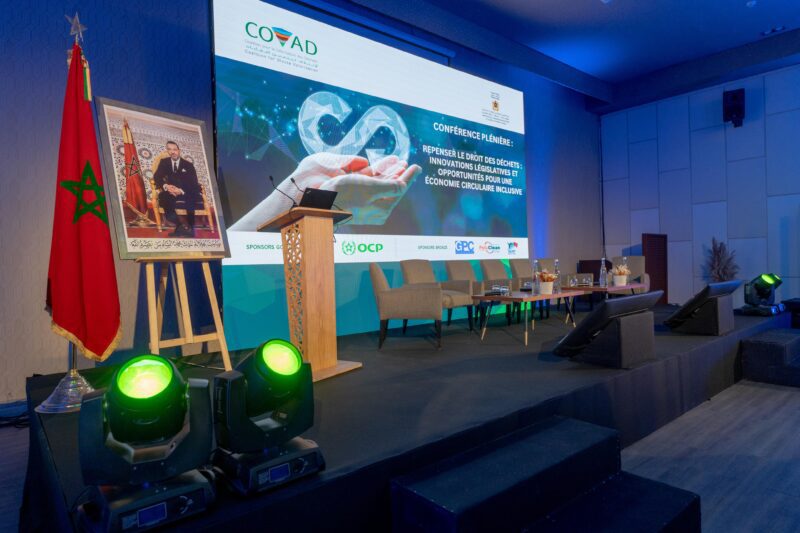
Gathered in Rabat for their annual plenary conference, stakeholders of the Coalition for Waste Valuation (COVAD) placed the reform of the legal framework for waste at the center of the debate on transitioning to a competitive and inclusive circular economy. Organized in partnership with the Ministry of Energy Transition and Sustainable Development, the event confirmed the rising significance of waste law as a structuring tool for industrial and environmental policy.
Held at the Dawliz hotel, the meeting brought together public officials, local elected representatives, economic operators, legal experts, and international partners, illustrating the growing role of COVAD as a public-private dialogue platform within the national circular economy ecosystem.
A legal reform at the heart of the transition
Co-chaired by Leila Benali, Minister of Energy Transition, and Mounir El Bari, President of COVAD, the conference revolved around two major themes. The first focused on the regulatory status, in light of the recent amendments to Law 28-00 governing waste management.
Discussions highlighted the advancements introduced by the reform, as well as the challenges related to its effective implementation: clarity of the framework, coordination between institutional levels, readability for investors, and operational capacity of local authorities. For speakers, the success of this reform is crucial for Morocco’s credibility as an attractive market for recycling and recovery sectors.
Transforming waste into industrial resources
The second panel concentrated on the economic opportunities offered by waste recovery, through experiences shared from strategic sectors such as end-of-life vehicles and construction and demolition waste. Discussions emphasized that transforming waste into secondary raw materials represents both an industrial competitiveness challenge and an environmental imperative.
Speakers stressed the need to secure resources, ensure stable industrial outlets, and adapt the regulatory framework to allow for the emergence of effective circular value chains.
Waste law as an economic lever
In a context of tightening environmental and commercial standards at the international level, the conference discussions converged on a central observation: the reform of waste law must become a lever to incentivize investment, innovation, and job creation. Aligning the national framework with international standards appears to be a key condition to support the upgrading of local sectors and strengthen their access to markets.
A coalition at the heart of the circular ecosystem
Established in 2015, COVAD has established itself as a key player in structuring the circular economy in Morocco. Its roadmap for 2021-2026 is based on pillars such as innovation, governance, and social inclusion. Among its achievements are significant contributions to the establishment of extended producer responsibility, reforming the legal framework for waste, developing markets for recycled materials, and international cooperation to combat plastic pollution.
Thanks to multi-stakeholder governance involving administrations, businesses, local authorities, NGOs, and experts, COVAD plays a role as a strategic interface between public policies and industrial dynamics. Its partnerships with international organizations like UNEP, UNIDO, and the European Union enhance national expertise and support the structuring of sectors.
Beyond the environmental challenge, this approach is part of a logic of industrial sovereignty, local value creation, and import substitution, making the circular economy a fundamental pillar of the Kingdom’s development model.