

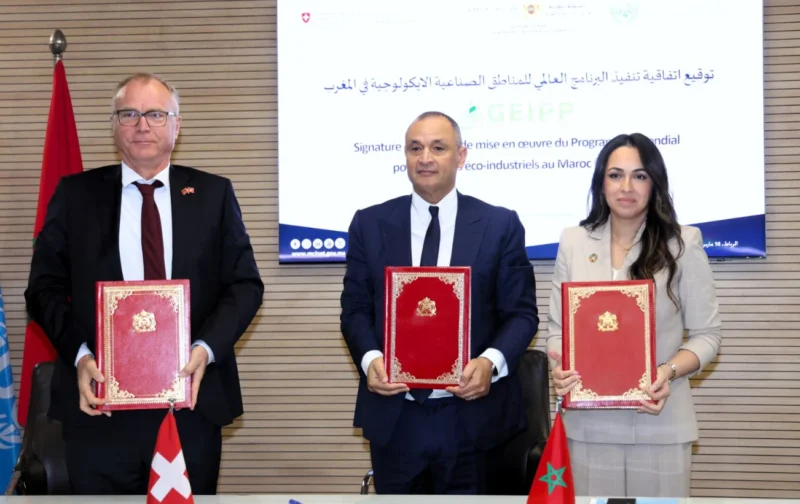
An agreement related to the implementation of the Global Program for Eco-Industrial Parks (GEIPP II) in Morocco was signed on Monday in Rabat, aimed at supporting the transition of Moroccan industrial areas into eco-industrial parks.
The agreement was signed by the Minister of Industry and Trade, Ryad Mezzour, the Swiss Ambassador to Morocco, Valentin Zellweger, and the UNIDO Country Representative in Morocco, Sanae Lahlou.
This new project represents a strategic milestone within a long-standing cooperation framework between Morocco, the Swiss Confederation, and UNIDO. It aligns with a shared vision to promote a more competitive, resilient, and environmentally friendly industry.
Its goals include enhancing the environmental and economic performance of industrial zones through resource efficiency, industrial synergies, and integrated management.
Developed based on lessons learned from the pilot phase in Morocco “EIP light touch” and interventions in other countries (Colombia, Peru, Ukraine, Vietnam, and South Africa), the project will capitalize on the results achieved and further embed the eco-industrial park approach (EIP) within the Moroccan context, ensuring a gradual nationwide rollout.
Implemented over three years (2026–2028) with an indicative budget of three million Swiss francs, the GEIPP Morocco aims to promote circular economy approaches within industries, reduce the climate footprint of the industrial sector, and enhance the capacity of industrial parks to adapt to the effects of climate change.
This initiative will thus contribute to inclusive and sustainable industrial development, grounded in the principles of the circular economy.
The intervention will also take into account the social dimension of development, addressing the country’s priority needs in this area.
On this occasion, Mr. Mezzour indicated that the project continues efforts to progressively improve the conditions for industrial operators by promoting increasingly clean production within industrial spaces. He emphasized that this direction was undertaken jointly with UNIDO and Swiss cooperation, which have supported Morocco in implementing these initiatives.
Mr. Mezzour also highlighted the importance of measuring and reducing the carbon footprint of industrial activities, noting that establishing tools for evaluating and certifying these performances is essential for international recognition.
For his part, Mr. Zellweger underscored that this initiative confirms the shared commitment to work closely to enhance economic competitiveness and foster job creation.
He stated that the project aims to make industrial parks greener, more sustainable, and more competitive while contributing to job creation.
Ms. Lahlou affirmed that the program seeks to assist the transition of Moroccan industrial parks into eco-industrial parks, highlighting that this approach specifically relies on reducing waste and CO2 emissions, optimizing energy and natural resource use, and developing synergies among businesses within the framework of industrial symbiosis.
Ms. Lahlou estimated that this initiative would strengthen the competitiveness of businesses while promoting decent job creation, adding that Morocco is positioning itself today as a model of sustainable industrial transition on the international stage.
The program aims to strengthen a national ecosystem conducive to the development of eco-industrial parks, fostering synergies with public policies and existing national initiatives. It will also align with the complementary dynamics of technical and financial partners, notably the World Bank Group and GIZ.
Through this initiative, the partners reaffirm their joint commitment to support the sustainable transformation of Moroccan industrial territories, enhance the competitiveness of the national industry, and increase its resilience to the effects of climate change.
MAP