

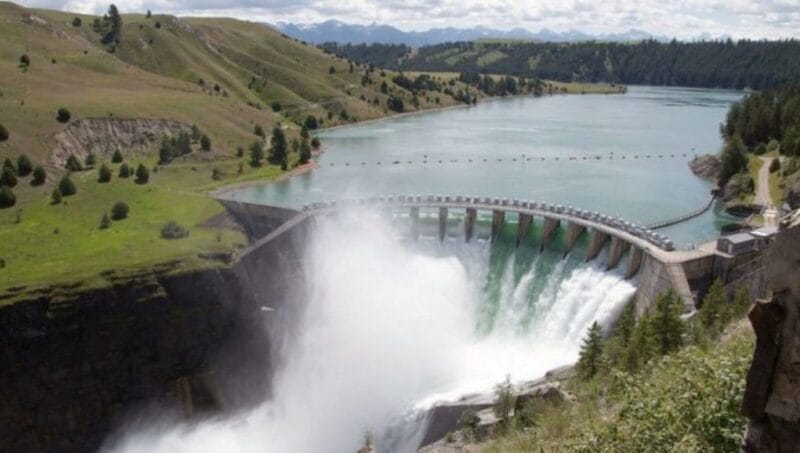
The water situation in Morocco has seen a significant improvement after several years marked by persistent water stress. In a speech delivered on Tuesday before the House of Councillors, the Minister of Equipment and Water, Nizar Baraka, reported a notable reversal of the trend, spurred by particularly favorable climatic conditions recorded since the beginning of the current hydrological year.
Cumulative rainfall since September has reached 121.5 millimeters, an increase of 114% compared to the same period last year. This volume also exceeds the average recorded over the past thirty years by 24%. Alongside these sustained rains, significant snowfall has covered up to 55,195 square kilometers before stabilizing at 22,600 square kilometers, significantly contributing to water resource replenishment.
This favorable situation has translated into substantial water inflows to the Kingdom’s dams. Between September 2025 and January 20, 2026, reservoirs recorded a total volume of 4.07 billion cubic meters, nearly 3.6 billion cubic meters of which occurred in the last forty days. As a result of these contributions, the overall filling rate of the dams has increased from 28% to 48%, providing a welcome respite for national reserves.
However, the evolution varies across hydraulic basins. The Sebou basin shows one of the most marked improvements, with a filling rate rising from 36% to 57%, corresponding to a stored volume of 3.16 billion cubic meters. This increase has led to the overflow of several dams. In the Oum Er-Rbia basin, reserves have significantly risen from 250 million cubic meters last year to 1.17 billion now, reflecting an increase in the filling rate from 5% to 24%.
The Bouregreg and Chaouia basins present an almost optimal situation, with the filling rate soaring from 37% to 95.5% and a stored volume of 1.03 billion cubic meters, accompanied by the overflow of several dams. Notable progress is also observed in the Loukos basin, where the filling rate stands at 64.3%, and in the Souss-Massa basin, which displays a volume of 382 million cubic meters, raising the filling rate to 52% and securing drinking water supply for at least an additional year.
The Tensift basin has regained a filling rate of 75.7%, a level comparable to that observed in July 2017, while the Guir-Ziz-Rheris basin shows slight progress at 57%. In contrast, the Drâa-Oued Noun and Moulouya basins remain at more stable levels of 31% and 39%, respectively. Overall, these volumes help consolidate national drinking water supply for a duration ranging from one to three years depending on the regions.
Beyond this conjunctural improvement, the Minister of Equipment and Water reminded that the Kingdom continues with a structural strategy aimed at sustainably strengthening its water security in the face of climate hazards. The interconnection of basins is a central axis of this policy, evidenced by the transfer of 953 million cubic meters from the Sebou basin to the Bouregreg basin, an operation conducted in an emergency situation and deemed successful.
In parallel, desalination of seawater is prioritized as a strategic necessity. The current production capacity, estimated at 350 million cubic meters per year, is expected to reach 1.7 billion cubic meters by 2030. Several stations are under construction, while other projects are planned in various regions of the Kingdom. The valorization of non-conventional resources constitutes another important lever, with a target of 100 million cubic meters of treated wastewater by 2027.
These efforts are complemented by ongoing drinking water supply programs benefiting remote communities and rural centers, within a framework of territorial equity. While the current improvement in the water situation offers a welcome reprieve, it is part of a long-term approach aimed at consolidating infrastructure and diversifying supply sources to ensure sustainable water security in the face of the challenges posed by climate change.