

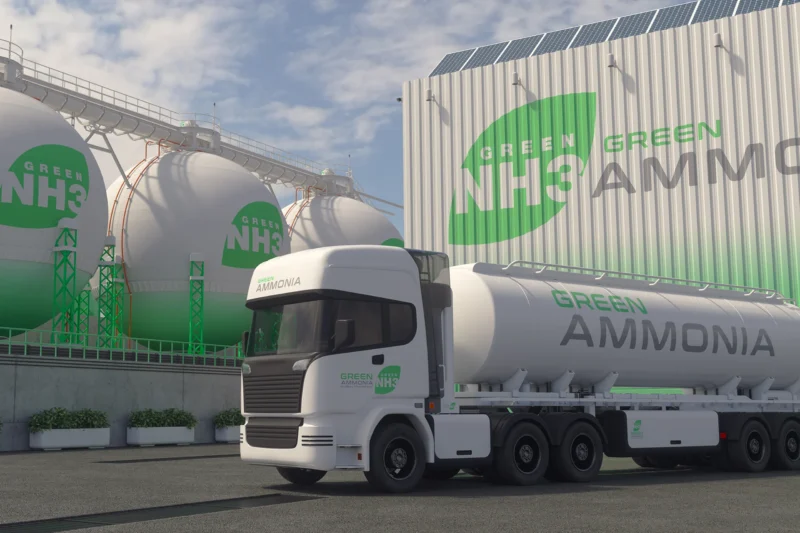
Morocco is now establishing itself as a key player in the future global landscape of decarbonized energy. A prominent German academic study ranks the Kingdom among the most competitive suppliers of green ammonia for Europe, alongside the United States and the United Arab Emirates, confirming a major strategic shift in its energy positioning.
Published in 2025 by the Brandenburg University of Technology (BTU) in Cottbus-Senftenberg, the report Green Ammonia: A Techno-Economic Supply Chain Optimization provides an in-depth analysis of global supply chains for green hydrogen and its main logistical vector, green ammonia. The findings are unequivocal: Morocco is one of the few countries able to combine very low production costs, geographical proximity to the European Union, and sufficiently developed infrastructure to sustainably participate in this emerging market.
The study is based on detailed cost modeling that encompasses the entire value chain, from renewable electricity production to the transport of hydrogen converted into ammonia to European markets. In this context, the Kingdom stands out for the abundance and competitiveness of its solar and wind resources, enabling low-cost electricity production, which is a crucial factor for the profitability of green hydrogen.
The authors emphasize that “competitive ammonia suppliers, notably Morocco, the United States, and the United Arab Emirates, benefit from very low renewable electricity costs,” adding that these advantages are expected to strengthen further by 2040, due to the continued decline in the costs of electrolyzers and synthesis technologies. In this perspective, green ammonia emerges as a strategic vector, serving both as an industrial raw material and a large-scale transport solution for hydrogen.
Beyond the technological dimension, the report highlights a fundamental shift in Morocco’s energy economy. The Kingdom is no longer limited to exporting green electricity or hosting renewable production projects; it is entering an integrated value chain paradigm that combines production, chemical processing, port logistics, and international contracting. Green ammonia thus becomes a strategic commodity, poised to play a role in a decarbonized context comparable to hydrocarbons in the previous century.
This evolution also aligns with a broader Euro-African dynamic. The study notes that Europe will not be able to meet its future demand for low-carbon hydrogen by itself, making imports essential for its energy sovereignty. Thanks to its geographical proximity and both Atlantic and Mediterranean coastlines, Morocco emerges as a central link in these new energy routes, designed to cross the Mediterranean not for oil or gas, but for green molecules.
Morocco’s centrality could also have regional implications. The capacity to produce and export green ammonia opens up prospects for supplying decarbonized fertilizers, clean fuels for maritime transport, and low-carbon industrial inputs, particularly for West Africa and the Sahel, which still heavily rely on hydrocarbon imports.
While the report focuses on economic and technical dimensions, its conclusions reflect an implicit strategic reality. By asserting itself as a potential supplier for the European energy transition, Morocco bolsters its diplomatic and industrial centrality. The authors caution that realizing this potential requires massive investments in electrolyzers, ammonia synthesis units, specialized port terminals, electrical networks, and strict adherence to European carbon certification requirements.
Through this academic recognition, Morocco confirms its ambition to become a structural actor in the global economy of “green molecules,” at the heart of the new energy routes of the 21st century.