
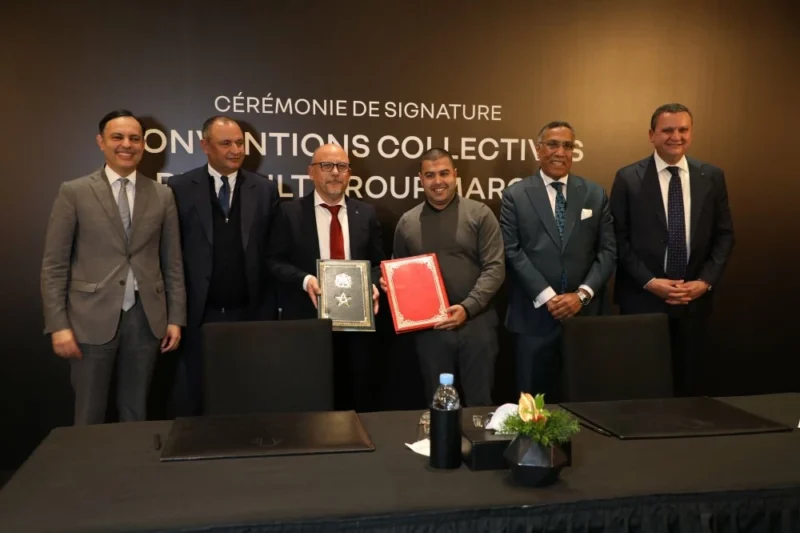
Renault Morocco has made a significant turn in its social management. The group signed a series of collective agreements in Casablanca covering all its industrial and commercial sites, reaffirming its commitment to firmly establish social dialogue at the heart of its development.
### A Unified Social Framework for Over 10,000 Employees
The agreements were concluded with the two main trade union federations in the country: the CDT for SOMACA and Renault Commerce Morocco, and the UMT for the Tangier plant. In the presence of Ministers Younes Sekkouri and Ryad Mezzour, these signatures lay the groundwork for a clear and shared framework regarding working conditions and social rights. More than 10,000 employees are affected.
Each entity has taken a symbolic step: the third renewal for Tangier and SOMACA, and the first collective agreement for Renault Commerce Morocco.
### A Signal of a Modern Industrial Morocco
For the Minister of Economic Inclusion, these agreements reflect the image of a Morocco that is modernizing its professional relations while balancing the needs of businesses with the expectations of workers. He particularly praised the priority given to hiring the children of employees, presented as a strong recognition.
The support system planned to manage activity peaks—especially in the case of launching new models—was also highlighted as a key element for competitiveness.
### Diversification and Upgrading: Expectations from the Ministry of Industry
Ryad Mezzour took the opportunity of this signature to emphasize the need for the Moroccan automotive sector to move beyond a cost-centered approach. According to him, the next step involves upgrading and increased diversification, a challenge that Renault is expected to accelerate.
He also stressed the importance of a trade union equipped with technical skills capable of supporting the sector’s transformation.
### Renault Morocco Highlights the Central Role of Human Capital
The group’s General Director, Mohamed Bachiri, presented these agreements as a crucial milestone in consolidating Renault’s social model in Morocco. He emphasized the strategic position of the Kingdom in the global setup of the manufacturer: nearly one in five vehicles sold worldwide comes from Moroccan plants.
According to him, the signed agreements result from thorough work conducted in a climate of trust, with one goal: to establish a stable social framework conducive to listening, progress, and collective development.
### Unions Satisfied with a Framework Described as Modern
At the UMT, Miloudi Moukharik praised the “modern” collective agreements that have long been awaited. He highlighted that a company the size of Renault deserves professional relationships that go far beyond the simple labor code, which is deemed insufficient for addressing the realities of the sector.
The CDT shares this assessment. Its Secretary-General, Khalid Alami Houir, sees these agreements as a decisive advancement, ensuring both the company’s competitiveness and the rights of workers. He emphasized the quality of social dialogue that made this possible.
### A Historical and Central Player in the Moroccan Automotive Landscape
Present in Morocco since 1928, Renault remains the undisputed market leader: more than one in three vehicles sold in the Kingdom bears the Renault or Dacia brands. With these new collective agreements, the group further entrenches its social model and confirms its intention to sustainably strengthen its presence.