

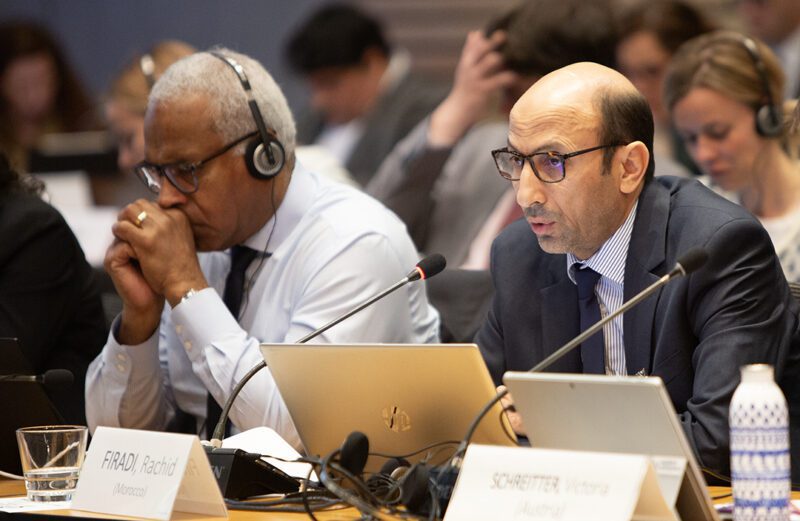
Morocco, under the enlightened vision of His Majesty King Mohammed VI, has made sustainable development and environmental protection national priorities, asserted Rachid Firadi, Director of Cooperation, Partnership, and Communication at the Ministry of Energy Transition and Sustainable Development, on Wednesday in Nairobi.
Speaking at a high-level panel organized by Morocco’s Permanent Mission to the UN Environment and its Slovenian counterpart under the theme “Promoting the right to a clean, healthy, and sustainable environment through a just transition,” held on the sidelines of UNEA-7, Firadi emphasized that this strategic direction “is enshrined in the Moroccan Constitution and integrated into the Kingdom’s new development model, in line with His Majesty King Mohammed VI’s vision.”
He added that the Kingdom takes pride in having joined the select group of countries that contributed to the first global recognition of this right through the resolutions of the Human Rights Council and the UN General Assembly, noting that these significant advancements remind us that environmental protection and the promotion of human rights are inseparable.
To translate these commitments into concrete actions, he continued, Morocco has raised its climate ambitions: the NDC 3.0 sets a target of reducing greenhouse gas emissions by 53%, while the national energy transition aims to bring the share of renewable electricity capacity to 52% by 2030, of which 46% has already been achieved.
Firadi indicated that a just transition is not limited to reducing emissions; it also requires strengthening resilience. Hence, the National Sustainable Development Strategy and the National Strategic Adaptation Plan of the Kingdom incorporate this dimension across all sectors to ensure that the country’s socio-economic development progresses in harmony with environmental protection.
For Morocco, the right to a healthy environment is a human rights imperative manifested through laws, institutions, the promotion of education, access to information, and meaningful citizen participation.
In this regard, Morocco has taken concrete measures by adopting robust environmental laws and establishing strong institutional mechanisms, including the National Commission for Sustainable Development and the National Commission on Climate and Biodiversity, he recalled.
Furthermore, the Mohammed VI Foundation for the Protection of the Environment plays a central role through its eco-schools and young environmental reporters programs that foster leadership and develop ecological skills, enabling thousands of Moroccan and African youth to actively participate in environmental and climate-related processes.
Morocco will continue to strengthen youth engagement, develop green skills ecosystems, and deepen regional cooperation, focusing on youth empowerment, resilient livelihoods, and environmental justice, he asserted.
Organized in partnership with delegations from the Maldives, Costa Rica, Mexico, along with the Child Rights International Network (CRIN), OHCHR, and the Major Group for Children and Youth (MGCY), this panel highlighted the need to accelerate the implementation of the right to a healthy environment, particularly through education for sustainable development, the promotion of green jobs, and enhancing youth participation in environmental governance processes.
Attendees included Inger Andersen, Executive Director of UNEP, the Minister of Environment, Climate, and Energy of Slovenia, the UN Special Rapporteur on toxic substances and human rights, and other UN and national officials from the international environmental ecosystem.
The theme chosen for this seventh United Nations Environment Assembly, “Advancing Sustainable Solutions for a Resilient Planet,” reflects the member states’ commitment to intensifying global environmental action and underscores the urgency of accelerating the implementation of effective solutions for a safer, inclusive, and equitable planet.
The UNEA brings together the 193 UN member states, alongside representatives from civil society, the private sector, and academia. The Assembly meets biennially and elects a bureau of ten members, including a president, eight vice-presidents, and a rapporteur, respecting the principle of equitable geographical distribution.
Morocco held the presidency of the United Nations Environment Assembly during UNEA-5.2 in March 2022, a mandate that continued until UNEA-6 in March 2024.
MAP Ecology