

Close Menu
Greentimes
    Qoui de neuf

    Casablanca: The Hajar Association Organizes a Charitable Chaâbana to Support Children with Primary Immunodeficiencies

    29 January 2026

    Food Sovereignty and Climate: The Court of Auditors Sounds the Alarm and Demands a New Direction

    29 January 2026

    Blue Economy: Dakhla Hosts Seafood 4 Africa 2026, a Strategic Meeting on Fishing and Aquaculture

    29 January 2026
    Facebook X (Twitter) Instagram
    GreentimesGreentimes
    • Home
    • CSR
    • Energy Transition and Renewables
    • Sustainability
    • Climate Change
    • Analyses and Opinions
    • Datas
    • Dates & events
    • Last news
    • FR
    Thursday 29 January 2026
    Facebook X (Twitter) Instagram
    Greentimes
    Home » COP30: UCLG Commends Morocco’s Leadership in Enabling Local Governments to Access Climate Finance
    Climate Change

    COP30: UCLG Commends Morocco’s Leadership in Enabling Local Governments to Access Climate Finance

    16 November 2025No Comments2 Mins Read
    Facebook Twitter Pinterest LinkedIn Tumblr Reddit WhatsApp Email
    Share
    Facebook Twitter LinkedIn Pinterest WhatsApp Email

    The regional and international leadership of Morocco in the territorialization of climate action has been praised by the World Organization of Local Governments, United Cities and Local Governments (UCLG), on the sidelines of COP30.

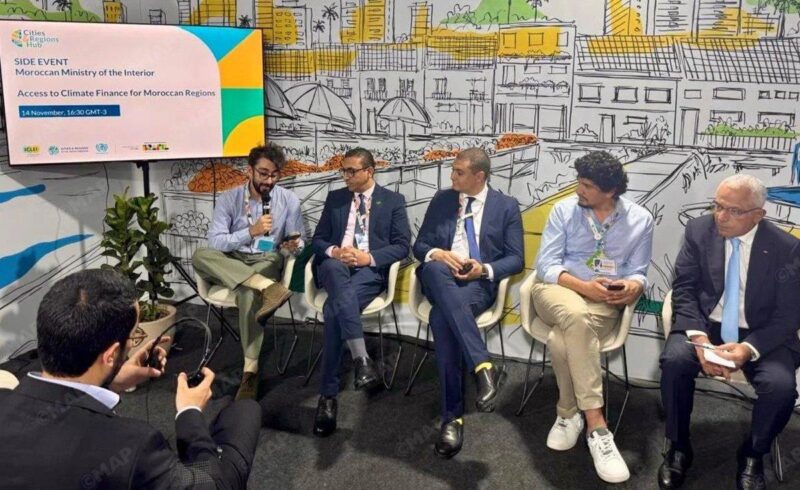
    During a side event dedicated to the access of Moroccan regions to climate finance, held on Friday in Belém, Pablo Mariani, UCLG’s climate officer, stated that the Kingdom “is among the first countries capable of demonstrating how a national architecture open to regions can enhance access to international funding, including for loss and damage.”

    According to him, the Moroccan vision “lays the foundations for a genuine territorial restoration, grounded in the real needs of the population.”

    Mariani commended the “driving role” of the General Directorate of Local Authorities (DGCT) and the Mohammed VI Foundation for the Protection of the Environment, as well as the ongoing commitment of national associations, which have made subnational climate action “a long-standing strategic priority.”

    The expert reminded that regions, provinces, and municipalities are “on the front line” facing the climate crisis, exposed to irreversible impacts ranging from the destruction of infrastructure to the loss of agricultural land and water networks. Hence, he emphasized the need for direct or simplified access for territories to international financing mechanisms.

    He advocated for the Fund to address loss and damage to include local funding windows tailored to the needs of communities and to formally recognize their place in the governance of the mechanism. “There can be no climate justice if territories do not have access to resources,” he insisted.

    He also highlighted the structuring role of intermediate cities, central to the Moroccan agenda, describing them as “platforms for social innovation capable of providing essential public services that form the first line of climate adaptation.”

    Looking ahead to the UCLG World Congress scheduled in Tangier in 2026, Mariani expressed that Morocco is “ideally positioned to showcase its advances in subnational climate finance” and to present a common position on community access to financing for loss and damage.

    He added that this meeting will also promote “a renewed vision of multi-level governance focused on public services, resilience, and territorial equity.” “Without financed territories, there will be no successful climate transition,” Mariani concluded, thanking Morocco for its “constant regional and international leadership.”

    CGLU climate action climate resilience environmental protection financing mechanisms international cooperation Leadership local communities regional governance territorial restoration
    Previous ArticleMorocco-Netherlands: Strengthened Energy Partnership on the Occasion of COP30
    Next Article Morocco Voices Support for Responsible and Sustainable Tourism at COP30

    Related Posts

    Food Sovereignty and Climate: The Court of Auditors Sounds the Alarm and Demands a New Direction

    29 January 2026

    FM6SS and Nareva Services Strengthen Their Partnership with a 1.2 MW Solar Power Plant in Dakhla

    28 January 2026

    ENOSIS welcomes a delegation from Columbia Business School as part of the EC Africa program.

    28 January 2026
    Leave A Reply Cancel Reply

    Ne ratez pas
    CSR

    Casablanca: The Hajar Association Organizes a Charitable Chaâbana to Support Children with Primary Immunodeficiencies

    29 January 20260

    The Hajar Association invites the public on February 5 in Casablanca for an evening dedicated…

    Food Sovereignty and Climate: The Court of Auditors Sounds the Alarm and Demands a New Direction

    29 January 2026

    Blue Economy: Dakhla Hosts Seafood 4 Africa 2026, a Strategic Meeting on Fishing and Aquaculture

    29 January 2026

    Solar: Noor Taroudant is Finally Set to Begin Construction After Land-Related Delays

    29 January 2026
    Restez connecté
    • Facebook
    • Twitter
    • Pinterest
    • Instagram
    • YouTube
    • Vimeo
    Nos vidéos

    The circular economy at the heart of LabelVie group’s initiatives.

    10 July 2025

    Mounir El Bari: “Our great ecological challenge is access to the resource!”

    10 July 2025

    Driss Nahya: “Control must be strengthened to access the waste deposit.”

    10 July 2025

    Reda Boukallal: “Priority to the valorization of household waste”

    10 July 2025
    Facebook X (Twitter) Instagram Pinterest
     
    © 2026 Green Times.

    Type above and press Enter to search. Press Esc to cancel.