

Morocco has emerged as one of the most dynamic countries on the continent in terms of water desalination. According to the latest report from the international firm Renub Research, the value of the Moroccan desalination market is expected to grow from $400 million in 2024 to $850 million by 2033, representing an increase of 112% over this period, with an estimated average annual growth rate of 8.7%.
This growth can be attributed to a combination of factors: the depletion of natural resources, significant public investments, the rise of renewable energy sources, and a growing demand for sustainable water, particularly in major cities.
### Desalination: A Pillar of Water Policy
Facing a series of droughts and the exhaustion of groundwater resources, Morocco has made desalination a strategic axis of its water policy. Major cities—Casablanca, Agadir, Safi, and Nador—are now the focus of the Kingdom’s efforts to ensure stable access to drinking water and to support agricultural and industrial needs.
These projects rely on public-private partnerships, deemed essential for attracting capital, stimulating innovation, and enhancing operational efficiency. However, the report also highlights persistent challenges: the high cost of facilities, the technical complexity of equipment, and the need to ensure equitable water distribution among regions.
### Cutting-Edge Technology for Sustainability
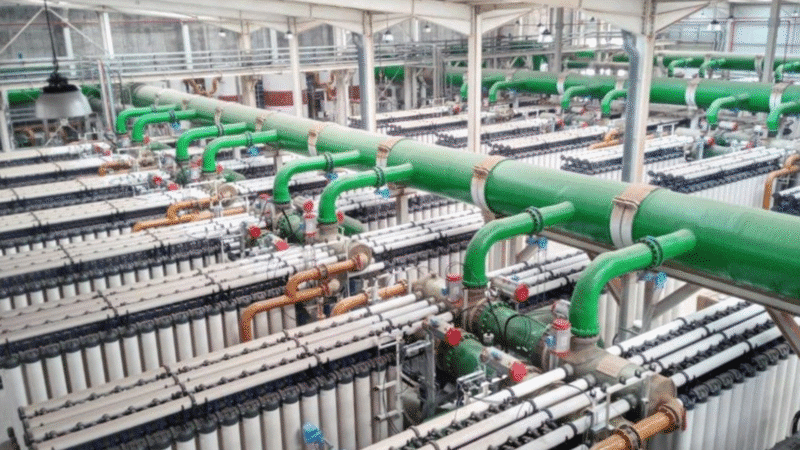
Morocco primarily relies on reverse osmosis technology, which is constantly being improved. New generations of membranes, energy recovery systems, and advanced automation processes enable a reduction in energy consumption while improving the quality of the produced water.
Another significant lever is the integration of solar and wind energy at desalination sites. This strategy not only lowers operating costs but also aligns the national water strategy with the Kingdom’s climate goals. The solar-powered Agadir plant already exemplifies this transition towards a cleaner and more sustainable water production model.
### Casablanca-Settat: A Symbolic Project
The most ambitious project remains that of Casablanca-Settat, which serves as a showcase for the National Program for Drinking Water Supply and Irrigation (PNAEPI 2020–2027), itself part of the National Water Plan 2020–2050. With a colossal budget of 143 billion dirhams, this complex will operate entirely on renewable energies.
Its first phase, scheduled for completion by the end of 2026, will produce 548,000 cubic meters of water daily, eventually reaching 822,000 cubic meters per day by 2028. Ultimately, it will supply over 7.5 million residents and ensure water security for the largest urban area in the country.
### National and Regional Growth
In the Oriental region, the Nador plant—with an annual capacity of 250 million cubic meters—will expand through a partnership with Lipu Industry (China), reaching 548,000 tons per day. These expansions align with the national goal of achieving 1.5 billion cubic meters of desalinated water per year by 2030.
Similarly, Safi and the Atlantic coast will see rapid production growth: the future Safi plant is expected to reach a daily capacity of 86,400 cubic meters, while the full operational deployment in Casablanca by 2028 will ensure 300 million cubic meters per year.
### A Strategic Bet for the Future
By doubling the size of its desalination market in less than ten years, Morocco asserts its commitment to sustainably secure its water resources while engaging in an energy transition. This technological and environmental shift, supported by unprecedented investments, positions the Kingdom as a model for integrated water management in Africa—sitting at the crossroads of economic, ecological, and social imperatives.