

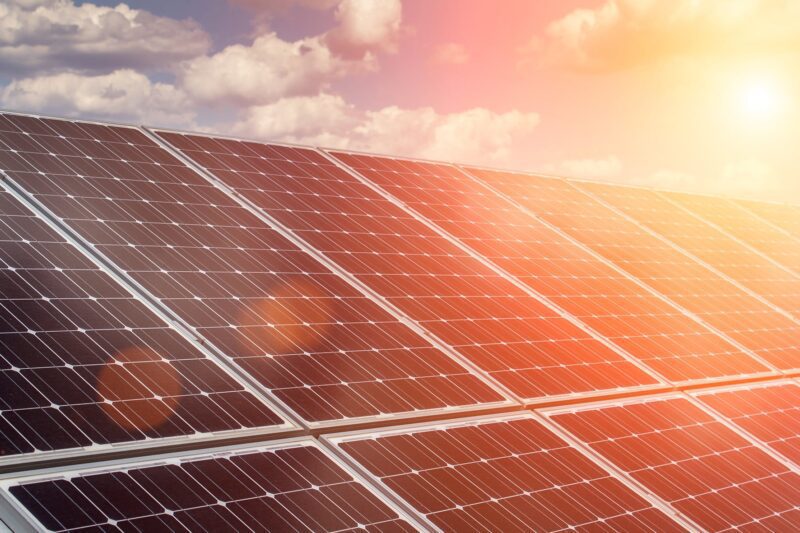
Morocco is accelerating its energy transition and preparing for a major scale shift, particularly driven by solar power and green hydrogen. According to L’Economiste, the Kingdom is no longer just increasing the share of renewable energy in its electricity mix; it now aims to become a regional hub for the production and export of clean energy.
A Changing Mix
The country’s installed electricity capacity currently stands at 12.2 GW. Of this total, 5.6 GW comes from renewable energies, accounting for 46% of the installed capacity and 27% of national production.
Solar energy, despite its significant potential, currently represents only 1,063 MW, or 19% of renewable production. This share is expected to grow rapidly.
By 2030, Morocco officially aims for 52% of its installed capacity to come from renewables. Some projections even suggest levels close to 60%, indicating a transition that is set to become structurally significant.
3 GW More in Solar by 2028
In the short term, the country plans to add 3 GW of solar capacity by 2028. The development of photovoltaics, particularly when coupled with storage batteries, is gaining traction due to decreasing costs and faster implementation.
The Solar Rooftop 500 program in Casablanca illustrates this commitment to promoting self-production and expanding access to solar energy.
Green Hydrogen: A New Industrial Ambition
Beyond electricity, Morocco is betting on green hydrogen to transform its energy model. Seven investors have been selected to launch an initial pipeline of projects representing $37 billion in investments.
These projects will mobilize 20 GW of renewable energy, with 10 GW dedicated to powering electrolyzers. The target is to produce up to 8 million tons of green hydrogen and its derivatives annually.
In this framework, solar energy is expected to contribute at least 3 GW. The Kingdom aims to export not only green electricity but also energy molecules.
Strengthening Infrastructure
This ramp-up requires massive investments in electrical infrastructure. The master plan for transportation allocates 25 billion dirhams to modernize and expand the network, including a third interconnection with Spain.
A direct current line connecting the south to the center of the country, estimated at 30 billion dirhams, will transport up to an additional 3 GW from regions with high solar and wind potential.
Meeting Growing Demand
National electricity demand is growing at 7.2% per year. To respond to this, a 120 billion dirham investment program plans to install an additional 15.6 GW, of which 12.4 GW will be from renewables.
Solar alone represents 40% of this plan, with 33 billion dirhams set aside for investment. Gas will play a supplementary role to ensure system flexibility.
On the ground, Masen is currently managing 2,443 MW in development, alongside 2,500 MW of battery storage capacity.
Through this strategy, Morocco is preparing a profound transformation of its energy model, combining supply security, decarbonization, and regional industrial ambition.
With L’Economiste