




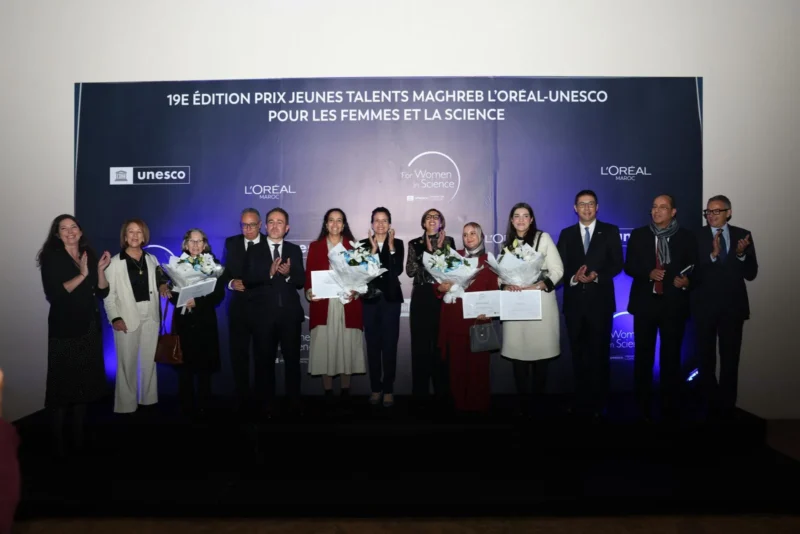
Five Maghreb researchers were honored on Monday in Rabat during the ceremony for the 19th edition of the Young Talents Maghreb L’Oréal-UNESCO “For Women in Science” program.
The awardees include Moroccan researchers Samira Oubannin, Ferdaous Idlahcen, and Sofia Sehli, along with Tunisian Souhir Belloumi and Algerian Samira Gouffi, each receiving a prize of €10,000 to support their scientific careers. The researchers excelled in diverse fields such as bioinformatics, biotechnology, civil engineering, analytical chemistry, and artificial intelligence.
For this 19th edition of the program, a jury composed of eminent scientific figures, chaired by Professor Abdelaziz Benjouad, Vice President for Research and Development at the International University of Rabat (UIR), selected the five researchers from numerous applications.
Speaking at the event, the Minister of Energy Transition and Sustainable Development, Leila Benali, praised L’Oréal and UNESCO for their initiative in promoting women researchers. She emphasized that in critical sectors such as energy, environment, and nuclear technology, the contribution of women is essential to address the significant current challenges related to economic and social transitions.
The minister highlighted the importance of investments made in laboratories and research centers, particularly in clean technologies, batteries, energy storage, and artificial intelligence applied to energy—domains where international competition is fierce and scientific excellence is crucial.
She encouraged young researchers to pursue their efforts with determination, assuring them of the support from institutions and the scientific ecosystem to accompany their journeys and allow them to fully contribute to Morocco’s scientific and technological development.
Meanwhile, Hicham El Habti, President of Mohammed VI Polytechnic University (UM6P), who spoke via videoconference, congratulated the laureates for their outstanding work, stating that their success is part of a long tradition of women’s contributions to scientific knowledge in the region.
Mr. El Habti reaffirmed the university’s commitment to promoting women in science, noting that women represent 55% of UM6P’s student community.
He also highlighted programs supporting young African researchers, particularly through the Mastercard Foundation Scholarship Program and the “African Women in Tech and AI” initiative.
Mr. El Habti further praised the L’Oréal-UNESCO partnership which provides young researchers with the tools, platforms, and recognition necessary to advance science, remarking that scientific excellence today carries the names and voices of women from the region.
For his part, Charaf Ahmimed, Regional Director of UNESCO for the Maghreb, noted that the partnership between UNESCO and L’Oréal, which has lasted for 27 years worldwide and since 2006 in Morocco, serves as an example of mentorship and role models.
Mr. Ahmimed specified that the program not only provides scholarships but also creates a network with other researchers at national, regional, and global levels, noting that this program is implemented in all countries where UNESCO and L’Oréal are present across five continents.
Despite the progress made in the region, much remains to be done, and these partnerships involving multiple stakeholders—political, private sector, United Nations, states, and UNESCO—enable collaborative efforts to promote better access for women to science, he reminded.
The General Director of L’Oréal Morocco, Laila Benjelloun, pointed out that this ceremony celebrates much more than scientific talent; it also honors the courage, perseverance, and resilience of these young women who have pushed the boundaries of knowledge and opened new paths for an entire generation.
“The world needs science, and science needs women, as they bring different perspectives, different lenses, and approach problems with an angle and sensitivity that allow for responses to current challenges viewed from another perspective,” Ms. Benjelloun stated.
This program not only provides funding to the laureates but also visibility, confidence, recognition, and the opportunity to join a community with former laureates who can support them, she added, emphasizing that each of the five awardees received a prize to support their ongoing scientific careers.
Since its launch in Morocco in 2006 and its expansion to the Maghreb in 2013, the L’Oréal-UNESCO program for Women in Science has recognized 90 young women scientists for the excellence of their work, thereby contributing to breaking the glass ceiling and promoting a more equitable and inclusive science in the region.
MAP