

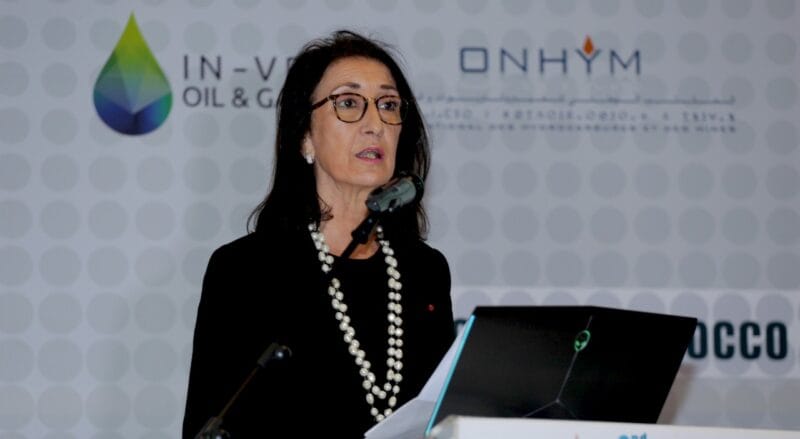
Natural gas is gradually establishing itself as a pillar of Morocco’s energy security, alongside renewables and green hydrogen. In an interview with Le Matin, Amina Benkhadra, the Managing Director of ONHYM, provides an overview of the most advanced projects and the prospects for national production.
Active Onshore Basins
Morocco’s gas potential is spread across several onshore and offshore basins.
In the Gharb basin, the first gas discovery zone in North Africa, several commercial deposits are being exploited. While the volumes are modest, they are profitable, particularly supplying industrial units in the Kénitra region.
The Essaouira basin, a historical producer of gas and condensate, continues to supply OCP, especially the Youssoufia site.
The Tendrara region in the northeast is now one of the most significant projects. Following exploration work conducted with Sound Energy, an exploitation concession has been granted. The first phase anticipates production starting in 2026 through a Micro-LNG project aimed at industries, then a second phase aimed at supplying ONEE power plants.
Other basins, such as Guercif, Zag, Boudenib, and Tadla, are in the exploration phase.
Offshore: Anchois and Boujdour in Focus
Offshore, the discovery of the Anchois deposit in the north confirms the potential of the Atlantic coast. In the south, drilling in the Boujdour area has revealed accumulations of gas and condensate.
However, these projects require significant investments and operate on long timelines, emphasizes Amina Benkhadra.
The Central Role of the Maghreb-Europe Gas Pipeline
Since the suspension of Algerian gas transit in 2021, ONHYM has taken over the management of the Maghreb-Europe Gas Pipeline (GME). Thanks to the “reverse flow” mechanism, operational since 2022, Morocco imports regasified liquefied natural gas (LNG) from Spain.
The system has been functioning uninterrupted, ensuring the supply to power plants.
Projects are underway to strengthen GME connections with the Al Wahda and Tahaddart plants. Additionally, an interconnection agreement has been signed to link the future 120 km Tendrara gas pipeline to the GME.
Gas and Energy Transition
In an energy mix characterized by the rise of renewables, gas is positioned to play a stabilizing role against the intermittency of solar and wind power.
ONHYM is also working on the strategic Atlantic Africa Nigeria-Morocco gas pipeline project, aimed at connecting West Africa to Morocco and Europe.
Hydrogen and Underground Storage
In parallel, the Office is developing projects related to geothermal energy, natural hydrogen, and underground storage.
Research on natural hydrogen is being conducted in several basins, with concentrations potentially reaching 1.7%. Studies are also underway for the storage of green hydrogen and CO₂ in suitable geological formations.
Underground gas storage is a priority area. Following a phase of identifying favorable sites, ONHYM plans comprehensive studies to assess mobilizable volumes and required investments.
National Production Starting in 2026
According to Amina Benkhadra, the Tendrara and Lixus projects are expected to enable an initial ramp-up of national production beginning at the end of 2026.
Ultimately, the Moroccan strategy relies on three levers: the development of national resources, enhancement of transport infrastructures, and establishment of storage capacities.
Gas is thus set to become the backbone of the energy transition, complementing renewables and green hydrogen, within a framework of sovereignty and energy security.
Source: Le Matin