

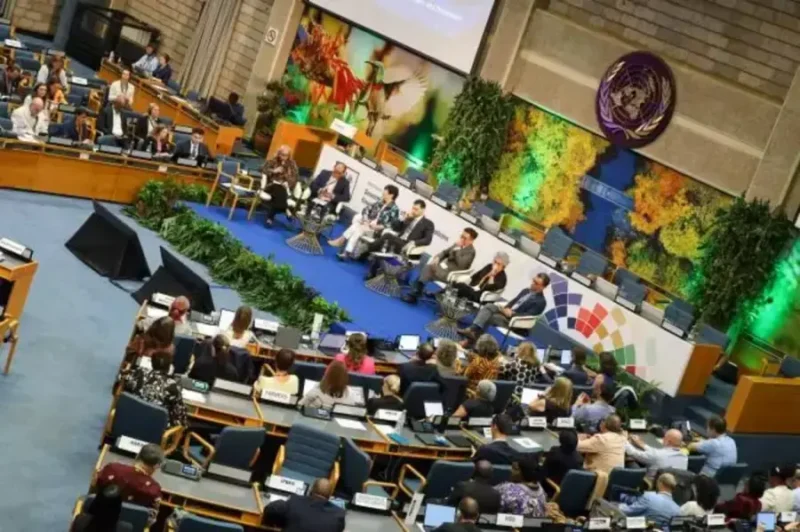
The central idea is a clear call for more effective, credible, and innovative multilateral cooperation to address global environmental challenges. On the occasion of the 7th United Nations Environment Assembly (UNEA-7), Morocco reaffirmed its belief that responding to climate crises requires better-coordinated and better-funded collective action.
Speaking during the high-level segment of UNEA-7, held in Nairobi, Abderrazzak Laassel, the Ambassador of the Kingdom to Kenya and South Sudan and Permanent Representative to the UN Environment, stressed the need to enhance synergies among various international environmental instruments. He emphasized that the goal is to optimize the use of available resources and to provide greater visibility to actions undertaken under the auspices of the United Nations Environment Programme.
For the Moroccan diplomat, international mobilization against climate change cannot be separated from an in-depth reflection on development financing mechanisms. It must also accompany a restoration of trust in multilateral cooperation, which is currently being tested by the scale and complexity of environmental issues.
In this context, Abderrazzak Laassel highlighted the approach adopted by Morocco, recalling that the Kingdom, under the leadership of His Majesty King Mohammed VI, has placed sustainability and climate protection at the heart of its public policies. The new development model constitutes, in his view, a structuring framework that reconciles economic growth, preservation of natural resources, and strengthening of governance.
He also noted that the National Strategy for Sustainable Development was developed following a broad participatory process involving public institutions, the private sector, and civil society, reflecting a commitment to inclusion and coherence in environmental action.
On the energy front, the Kingdom’s representative reminded the assembly of the progress made in the transition to renewable energies and energy efficiency. Morocco has committed to reducing its dependence on fossil fuels and its greenhouse gas emissions while enhancing its energy independence. Today, the installed electricity capacity reaches 12 gigawatts, with 46% coming from renewable sources, aiming for 52% by 2026, mainly in the southern provinces.
Additionally, the Kingdom aspires to quadruple investments in clean energies and quintuple the electricity network, paving the way for a new phase focused on the development of carbon-free green hydrogen.
At the African level, Morocco reiterated its commitment to a healthy and sustainable environment through several major initiatives, including one aimed at facilitating access for Sahel countries to the Atlantic, African climate commissions, and the initiative for agricultural adaptation in Africa, dedicated to the continent’s food security.
Morocco is participating in this 7th session of UNEA, organized from December 8 to 12 in Nairobi, with a delegation comprised of officials from the Ministry of Energy Transition and Sustainable Development and the Kingdom’s embassy on-site. This edition examines 19 draft resolutions and decisions covering themes such as artificial intelligence, minerals and metals, forest fires, and hydrological cycles, in a framework that brings together all 193 member states of the United Nations, alongside civil society actors, the private sector, and the academic world.