

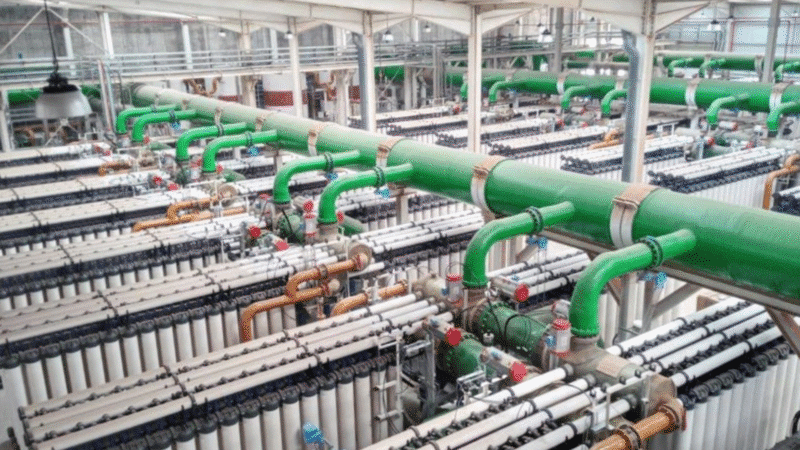
Morocco is preparing to take a new step in its water strategy. According to Nizar Baraka, Minister of Equipment and Water, desalination plants will cover 60% of the country’s drinking water needs by 2030, up from about 25% currently. The announcement was made during the recent World Water Congress held in Marrakech.
The current plan aims for an annual capacity of 1.7 billion cubic meters of desalinated water by 2030. Future volumes will come from ongoing projects, as well as new plants for which tenders will be launched as early as next year.
A major project will be established near Tiznit, with an announced investment of 10 billion dirhams. This facility will have a capacity of 350 million cubic meters, serving both urban supply in the southern regions and agricultural irrigation. Preparatory studies are underway, and the tender is expected to be launched by mid-next year, the minister specified.
Beyond Tiznit, additional units are planned in Nador, Tangier, and Rabat, in partnership with the French group Veolia. In Tantan, the government is also considering linking the desalination plant to a port intended for the export of green hydrogen and ammonia.
Developing Infrastructure and Sustainable Direction
The Kingdom currently has 17 desalination units producing 345 million cubic meters of water annually. Four more are under construction, which will add an additional 540 million cubic meters by 2027. Among them is a station intended for Casablanca to meet the growing demand of the metropolis.
All future installations will be powered by renewable energy, Nizar Baraka emphasized. This direction aims to maintain consistency with the country’s climate commitments.
The minister also pointed to a problem exacerbated by rising temperatures: evaporation in dams, which can reach up to 30% of surface water resources. To limit these losses, innovative solutions are being tested, including floating solar panels. An experiment is underway on a dam near Tangier and could be extended to infrastructure in the south and mountainous areas.
This structural program commits Morocco to a sustainable securing of its water resources while supporting vital sectors, notably agricultural production, and integrating this transformation within a framework of clean energy.