

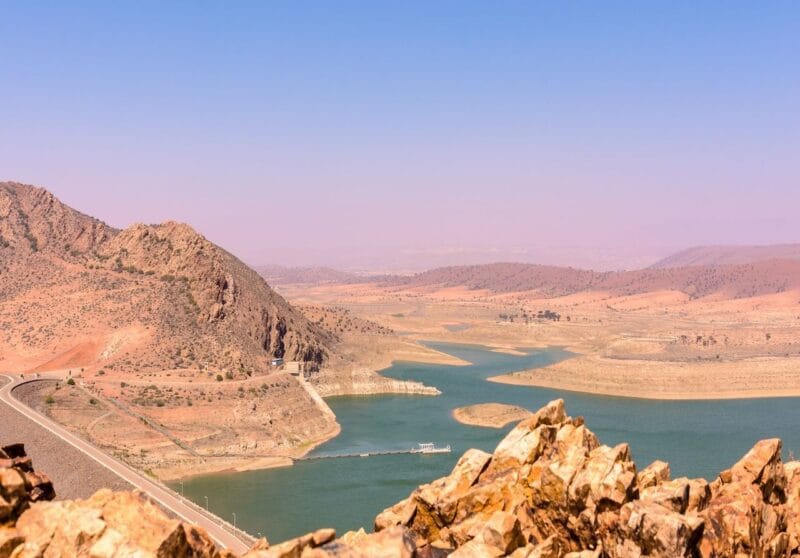
As reservoirs display remarkable health this spring of 2026, international cooperation accelerates its support for the national water strategy. A new loan of 100 million euros from the German KfW solidifies the Kingdom’s structural shift, focusing on massive desalination and inter-basin connections.
Morocco and Germany are strengthening their strategic partnership in water. According to our information, the German Development Bank (KfW) is preparing to release funding of 100 million euros. This financial aid, to be deployed between late 2026 and 2028, is not just aimed at building pipes but also at supporting a profound transformation of sector governance, particularly emphasizing inclusion and climate resilience.
A Favorable Sky and Doubling Reserves
This boost comes in a paradoxically promising context. After years of intense drought, recent rainfall has revitalized national infrastructure. As of March 21, 2026, reservoir levels surged to 72.1%, with reserves exceeding 12.3 billion cubic meters. In just one year, the country’s water stock has doubled, providing a welcome breath of fresh air to farmers and urban residents.
However, Rabat does not succumb to euphoria. Under the guidance of Royal High Directions, the country maintains its course: ending exclusive dependence on rainfall. The goal is clear: increase desalination capacity to 1.7 billion cubic meters per year by 2030. The giant projects in Casablanca, the Oriental region, and Souss-Massa are progressing rapidly, driven by public-private partnerships (PPPs) that have now become the standard for funding in the sector.
The Water Highway: Salvation from the North
Another pillar of this water sovereignty lies in inter-basin connectivity. The project linking the Sebou and Bouregreg rivers, a true “water highway” with a budget of 6 billion dirhams, is already securing the Rabat-Casablanca corridor. To prevent any drop from reaching the Atlantic, further ambitious transfers, particularly from Oued Laou to Oum Er-Rbia, are currently under study to recover nearly 1 billion cubic meters annually.
Rural World and Agriculture at the Heart of Priorities
The social aspect is also prioritized. The 2026 Finance Bill dedicates massive efforts to supply remote areas, with over 10,000 douars already connected. Meanwhile, the drip irrigation revolution continues in the plains: nearly 867,000 hectares are now equipped with localized irrigation, a crucial modernization for a agricultural sector that remains the largest consumer of this resource.
Finally, Morocco is banking on the circular economy. With an urban sewage connection rate of 84% and an increasing reuse of wastewater for irrigating green spaces and golf courses, the country is optimizing every cubic meter.
By securing this new German financing, the Kingdom demonstrates that its water policy has become a benchmark of confidence for international donors, establishing the country as a global laboratory for managing scarcity.