

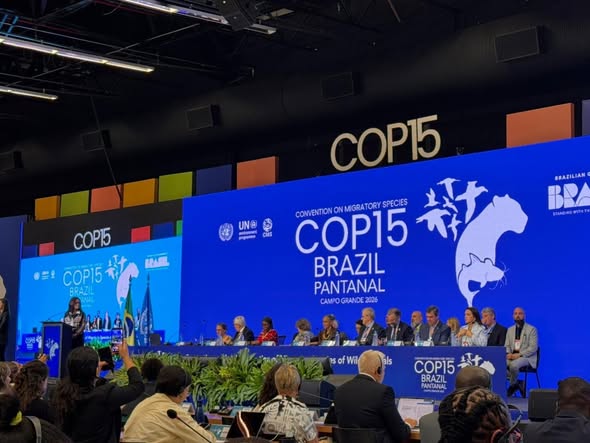
Four months after hosting the Climate Conference (COP30) in Belém, Amazon, Brazil reaffirms its commitment to sustainable development and multilateralism by organizing this new triennial meeting dedicated to biodiversity.
Under the theme “Connecting Nature to Preserve Life,” this gathering brings together governments, experts, scientists, and civil society until March 29 to address issues related to the conservation of migratory species.
Morocco is participating with a delegation from the National Agency for Water and Forests to highlight efforts in protecting endangered species. Initiatives presented include a program for the conservation of Saharan megafauna, the national strategy dedicated to raptors, the development of the protected areas network, and the conservation of wetlands, which are crucial stopovers for migratory birds.
Located at the crossroads of Europe and Africa and traversed by one of the world’s major migratory bird pathways, Morocco places particular importance on this conference, aligning with its international commitments to preserve biodiversity and this shared natural heritage.
According to Brazil’s Minister of Environment and Climate Change, Marina Silva, COP15 aims to connect nations, policies, science, and traditional knowledge to ensure migratory species can follow their routes, as nearly 49% of species are declining and 24% are threatened with extinction.
“If we work together, it is possible to reconcile development and conservation, to generate wealth without destroying the natural heritage that supports us,” the minister emphasized, noting that pressure factors such as the climate crisis, ecosystem degradation, biodiversity loss, and pollution affect not only migratory species but also food security, water quality, and the balance of life on our planet.
The Convention on Migratory Species (CMS) currently has 133 Parties and encompasses 1,189 species, predominantly birds, but also terrestrial and aquatic mammals, fish, and reptiles.
Migratory species play a fundamental role in the balance of ecosystems that support life on Earth, both ecologically and economically, as well as culturally. They perform essential functions, such as transporting nutrients between terrestrial, aquatic, and marine environments, contributing to crop pollination, seed dispersion, and supporting sustainable economic activities like ecotourism.
They are also valuable indicators of environmental health, as changes in their populations or behaviors can signal disturbances along their migratory routes.
However, these species face increasing threats. According to Convention data, habitat loss, degradation, and fragmentation affect nearly 75% of migratory species, while overexploitation impacts about 70%.
Agricultural expansion is among the main factors degrading habitats, alongside hydraulic infrastructure, such as dams, which disrupt fish migration by breaking the connectivity of waterways. Overexploitation arises from excessive harvesting of species beyond their renewal capacity, particularly for food, commercial, or artisanal purposes.
As the host for this conference for the first time, Brazil, which houses some of the planet’s richest ecosystems, including the Amazon and the Pantanal, positions itself as a strategic corridor for many migratory species and intends to actively contribute to international conservation efforts.
Throughout the week, negotiations in the “Blue Zone” will focus within the Plenary Committee and thematic groups on the conservation status of migratory species, climate change, ecological connectivity, and the impacts of human activities.
The agenda also includes reviewing action plans dedicated to marine species, birds, and terrestrial species, as well as studying proposals for the listing or revision of species in the Convention’s annexes.
In parallel with formal negotiations, side events, regional meetings, and working groups will be organized to advance technical and political discussions and promote international cooperation in biodiversity protection.