

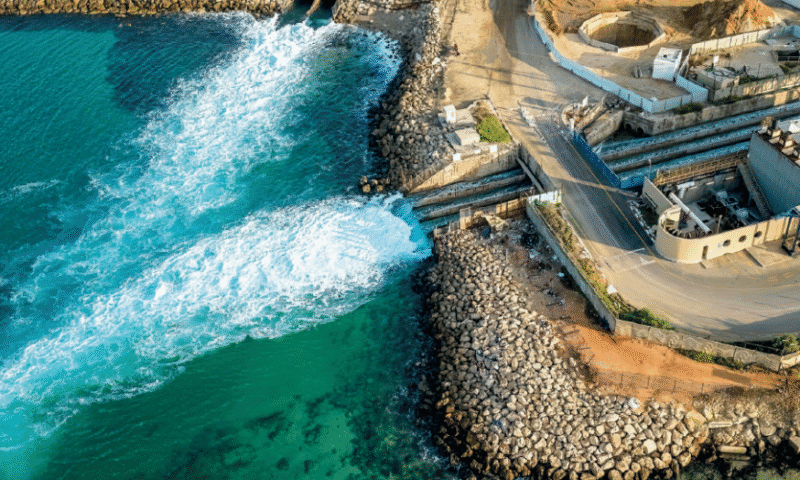
In response to years of drought and variability in precipitation, Morocco is accelerating the transformation of its water policy by focusing on a diversified water mix that combines dams, seawater desalination, inter-basin transfers, and the reuse of wastewater.
Expanding Storage Capacity
The Kingdom currently has 156 large dams with a total storage capacity of approximately 20.8 billion m³, according to the Minister of Equipment and Water, Nizar Baraka.
Since 2022, seven new dams have been commissioned, while 14 large dams and five medium-sized dams are currently under construction. These projects are expected to add nearly 5 billion m³ of additional capacity, raising the national potential to approximately 25.8 billion m³.
The network also includes 150 small and medium-sized dams, with 155 new structures planned by 2027.
Desalination as a Strategic Pillar
The succession of droughts between 2018 and 2025 has exposed the limitations of a model heavily reliant on dams. Therefore, Morocco is accelerating the development of seawater desalination.
Desalinated water production has increased from 40 million m³ in 2021 to approximately 350 million m³ today, thanks to 17 operational plants.
The goal is to reach 1.7 billion m³ annually by 2030, which could meet nearly 60% of the country’s drinking water needs.
These infrastructures are intended to secure water supply for major cities like Casablanca, Rabat, Tangier, and Agadir, as well as to support agriculture. Approximately 500 million m³ of desalinated water is expected to be allocated for irrigation, allowing the irrigation of nearly 100,000 hectares of farmland.
Water Highways
Another lever of this strategy is the transfer of water between hydraulic basins.
A first infrastructure already connects the Sebou and Bouregreg basins, enabling the transfer of 953 million m³ of water between 2023 and 2025 to secure the supply for the Rabat-Casablanca axis.
The next phase aims to extend towards the Oum Er-Rbia basin, with a project of 210 km capable of transferring up to 1.2 billion m³ of water annually. A third phase is set to connect the Laou-Loukkos-Sebou basins to enhance the supply of drinking water and irrigation.
Developing Wastewater Reuse
The water strategy also encompasses the reuse of treated wastewater.
Currently, 14 Moroccan cities have treatment plants producing approximately 52 million m³ of treated water per year, primarily used for irrigating green spaces and sports facilities.
Morocco plans to double this volume to reach 100 million m³ by 2027.
Management Tailored to Regional Specificities
This approach is tailored to the needs of different hydraulic basins:
- Oum Er-Rbia: construction or elevation of 8 dams and development of desalination and reuse.
- Tensift: enhancement of resources with 5 additional dams and desalination.
- Souss-Massa: a combination of dams and desalination to support agriculture.
- Moulouya: new dams and a desalination plant in Nador.
Through this multidimensional strategy, Morocco seeks to secure its water resources sustainably and better cope with the effects of climate change.
With Le360