

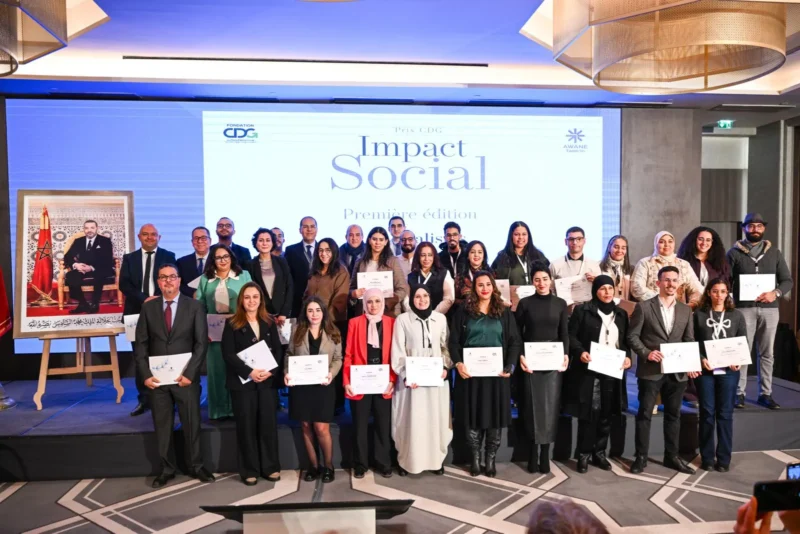
The CDG Foundation organized a ceremony on Thursday in Rabat to present the CDG – Social Impact Award, honoring three winning associations among 15 supported through a boot camp focused on impact-driven management and strengthening the culture of impact measurement.
This initiative aims to bolster the capabilities of the Moroccan third sector in evaluating and measuring social impact, a strategic focus of the Foundation that seeks to enhance the crucial role of associations in creating social and economic value.
Held in the presence of senior officials and partners from the associative ecosystem, the ceremony featured the presentation of “Evaluation and Social Impact Measurement” certificates to the 15 beneficiary associations of the program, as well as the announcement of the three winners: “SANADY Foundation,” “AIDECA,” and “Moroccan Association of the Disabled (AMH).” Six associations made it to the finals of this first edition, which received 84 applications.
“Managing social impact means ensuring that our actions bring about real change in the long term,” emphasized Wafaa Naim El Idrissi, the General Director of the CDG Foundation, on this occasion.
She indicated that this framework aims to conduct collective foundational work to highlight the key role of the third sector, promote best practices, and reinforce the culture of social impact.
Ms. El Idrissi reminded attendees that the CDG Foundation places the ultimate goal of social impact at the heart of its actions, intervening at various stages of association development through the Start (emergence), Boost (momentum), and Scale (growth) initiatives.
She also announced plans to deploy training campuses in other regions, with an initial stage scheduled in Ouarzazate, and the imminent launch of the first cohort of a certifying pathway in governance for social and solidarity economy organizations, in partnership with the International University of Rabat and the Moroccan Institute of Directors.
On his part, Mohammed Dardouri, the National Coordinator of the National Initiative for Human Development (INDH), emphasized the importance of impact evaluation in public policies, noting that the INDH has integrated a dedicated unit for monitoring, evaluation, and measurement of impact since 2018, during the launch of its third phase.
This approach enables “public policies to land where they are needed, essentially bridging supply and demand,” he explained, citing the example of the community health program deployed across three major regions to improve maternal and child health.
“We have focused on behavior change, particularly regarding breastfeeding, increasing the percentage of women breastfeeding naturally from 35% to 45%,” said Mr. Dardouri.
He also highlighted encouraging results in reducing maternal and child mortality, with “virtually zero deaths” reported in several intervention areas, demonstrating the tangible impact of the change theories implemented since 2019.
The ceremony also featured a panel discussion entitled “Managing by Impact: Methods & Practices, Challenges & Issues,” led by Murielle Chauvel, Director of ESSEC Impact Unlimited; Manal El Abboubi, Professor at Mohammed V University and Coordinator of the Social Innovations Chair at HEM Research Center; and Imane Fahli, Senior Policy Advisor at the Tony Blair Institute for Global Change.
The three experts shared their experiences in measuring and managing social impact. They also discussed methodologies for impact evaluation adapted to the Moroccan context, challenges related to data collection and attribution of results, and international best practices that could inspire the development of the national associative sector.
The speakers emphasized the importance of a structured and rigorous approach to demonstrate the added value of social interventions and strengthen the credibility of associations with their stakeholders.
The event underscores the collective commitment to the structuring and professionalization of the Moroccan associative sector, particularly through the enhancement of the culture of impact and the adoption of rigorous measurement tools suited to the national context.
MAP