

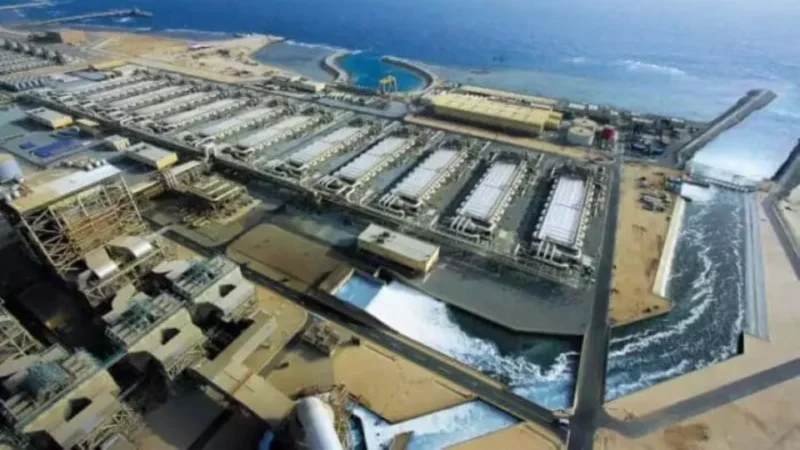
In the face of worsening water stress and repeated episodes of drought, desalination of seawater is gradually becoming a prominent topic in Moroccan agricultural discussions. Historically limited to supplying drinking water, this technology is now being considered as a means to secure certain agricultural productions. However, its high cost, territorial impacts, and economic limits make it a niche solution, difficult to apply broadly across the agricultural sector.
A water-dependent agriculture
According to experts cited by Finances News Hebdo, Moroccan agriculture utilizes nearly 80% of the country’s water resources. However, this reality deserves some nuance. As Mohammed Taher Srairi, a researcher and specialist in agricultural and water systems, reminds us, rain remains the primary source of agricultural water, an aspect often underestimated in international comparisons.
In temperate or tropical regions, agricultural performance largely depends on regular precipitation. In contrast, Morocco, a semi-arid country, has built its modern agricultural model on the development of irrigation, supported by large dams and intensive mobilization of water resources. This choice has facilitated the rise of high-value export sectors, particularly fruits, vegetables, and greenhouse crops, in regions such as Souss-Massa, Moulouya, and Haouz.
An agricultural model at saturation
Today, this model is showing its limits. The margins for expanding irrigation are shrinking, a phenomenon also observed in other regions of the world facing water stress, such as California or southern Spain. It is within this context that desalination emerges as a non-conventional resource, capable of prolonging or even saving certain threatened agricultural systems.
The example of Chtouka-Aït Baha in the Agadir region illustrates this potential. The desalination plant, commissioned in the early 2020s, produces about 275,000 m³ of water per day, nearly half of which is allocated to irrigation. It supplies more than 15,000 hectares of greenhouse crops, contributing to maintaining a high-performing export agriculture. An ongoing expansion aims to increase the capacity to 400,000 m³ per day by 2026.
A cost incompatible with most crops
Nevertheless, this local success cannot be generalized. The main constraint remains economic. The cost of desalinated water is around $0.50 per cubic meter, which is at least five dirhams, and likely more when accounting for all real costs. These include initial investment, energy consumption, brine management, environmental impacts, and long-term financial burdens.
At this price level, only high-value-added crops can sustainably absorb the cost of desalinated water. Cereals, fodders, livestock, and traditional tree farming are excluded. Even some intensive sectors, such as citrus farming, see their profitability weakened when irrigation relies on desalination, especially when water must be transported over long distances.
Risks of territorial inequalities
Beyond farm profitability, desalination presents a major territorial challenge. Coastal regions, close to desalination plants, enjoy structural advantages, while inland areas must bear high additional costs related to the transport and pumping of water. Large-scale water transfer projects, sometimes referred to as “water highways,” illustrate the scale of necessary investments.
If this equation remains relatively manageable for drinking water in urban settings, where consumption volumes are limited, it becomes much more fragile in agriculture, where demands are massive. Hence, there is a need for great strategic caution.
An official orientation embraced
Public policies are aligned with this direction. Morocco currently operates 17 desalination plants, producing around 345 million m³ of water annually. By 2030, national capacity is expected to reach 1.7 billion m³ per year, thanks to new projects in Casablanca, Dakhla, Safi, and El Jadida.
However, the majority of this volume is intended for drinking water and industrial uses. Authorities have clearly stated that desalinated water is not intended for irrigating extensive crops.
Toward a more selective agriculture
In the medium term, a decrease in costs is not excluded, thanks to technological advancements, integration of renewable energies, or future valorization of brine. However, these prospects remain uncertain in the Moroccan context.
In the meantime, desalination outlines the contours of a more selective agriculture, focused on coastal areas, capital-intensive operations, and high-value-added crops. This represents a profound transformation of the agricultural landscape, promising performance for some territories but also risks of increased inequalities at the national level.
With Finances News