

Close Menu
Greentimes
    Qoui de neuf

    Transformation of ONHYM: Green Light from the House of Representatives

    5 February 2026

    Secoex Renovables Prepares for Its Launch in the Moroccan Solar Self-Consumption Market

    5 February 2026

    Afforestation: The Court of Auditors Highlights a Waste of 92 Million Dirhams in the Waters and Forests Sector

    5 February 2026
    Facebook X (Twitter) Instagram
    GreentimesGreentimes
    • Home
    • CSR
    • Energy Transition and Renewables
    • Sustainability
    • Climate Change
    • Analyses and Opinions
    • Datas
    • Dates & events
    • Last news
    • FR
    Thursday 5 February 2026
    Facebook X (Twitter) Instagram
    Greentimes
    Home » Desalination expected to provide 60% of drinking water by 2030
    Climate Change

    Desalination expected to provide 60% of drinking water by 2030

    5 December 2025No Comments2 Mins Read
    Facebook Twitter Pinterest LinkedIn Tumblr Reddit WhatsApp Email
    Share
    Facebook Twitter LinkedIn Pinterest WhatsApp Email

    Morocco is preparing to take a new step in its water strategy. According to Nizar Baraka, Minister of Equipment and Water, desalination plants will cover 60% of the country’s drinking water needs by 2030, up from about 25% currently. The announcement was made during the recent World Water Congress held in Marrakech.

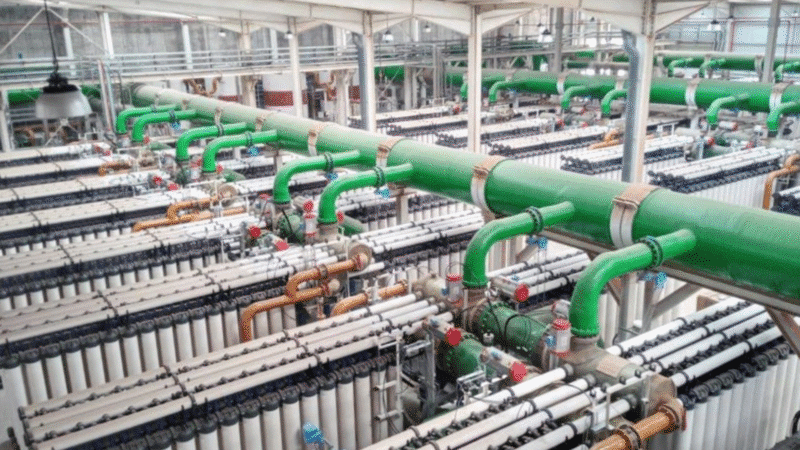
    The current plan aims for an annual capacity of 1.7 billion cubic meters of desalinated water by 2030. Future volumes will come from ongoing projects, as well as new plants for which tenders will be launched as early as next year.

    A major project will be established near Tiznit, with an announced investment of 10 billion dirhams. This facility will have a capacity of 350 million cubic meters, serving both urban supply in the southern regions and agricultural irrigation. Preparatory studies are underway, and the tender is expected to be launched by mid-next year, the minister specified.

    Beyond Tiznit, additional units are planned in Nador, Tangier, and Rabat, in partnership with the French group Veolia. In Tantan, the government is also considering linking the desalination plant to a port intended for the export of green hydrogen and ammonia.

    Developing Infrastructure and Sustainable Direction

    The Kingdom currently has 17 desalination units producing 345 million cubic meters of water annually. Four more are under construction, which will add an additional 540 million cubic meters by 2027. Among them is a station intended for Casablanca to meet the growing demand of the metropolis.

    All future installations will be powered by renewable energy, Nizar Baraka emphasized. This direction aims to maintain consistency with the country’s climate commitments.

    The minister also pointed to a problem exacerbated by rising temperatures: evaporation in dams, which can reach up to 30% of surface water resources. To limit these losses, innovative solutions are being tested, including floating solar panels. An experiment is underway on a dam near Tangier and could be extended to infrastructure in the south and mountainous areas.

    This structural program commits Morocco to a sustainable securing of its water resources while supporting vital sectors, notably agricultural production, and integrating this transformation within a framework of clean energy.

    agricultural irrigation climate change desalination energy efficiency freshwater supply infrastructure investment international partnerships renewable energy sustainable development water management
    Previous ArticleUSA: Trump Eases Standards on Vehicle Consumption and Emissions
    Next Article Water: Morocco Shifts Towards a Model of Permanent Water Security

    Related Posts

    LNG: Why Morocco is Betting on Liquefied Gas to Secure Its Energy Supply and Accelerate Its Transition

    4 February 2026

    Casablanca: The AMEE launches the ThermoPro label to structure the thermal solar sector and enhance the quality of installations.

    4 February 2026

    Transformation of ONHYM into a Public Limited Company: The House of Representatives Adopts the Draft Law

    4 February 2026
    Leave A Reply Cancel Reply

    Ne ratez pas
    Energy Transition and Renewables

    Transformation of ONHYM: Green Light from the House of Representatives

    5 February 20260

    The House of Representatives adopted by majority on Tuesday in Rabat the bill No. 56.24…

    Secoex Renovables Prepares for Its Launch in the Moroccan Solar Self-Consumption Market

    5 February 2026

    Afforestation: The Court of Auditors Highlights a Waste of 92 Million Dirhams in the Waters and Forests Sector

    5 February 2026

    AMIFA (Groupe BCP) crowned “Champion of African Financial Inclusion” at the Financial Afrik Awards 2026

    4 February 2026
    Restez connecté
    • Facebook
    • Twitter
    • Pinterest
    • Instagram
    • YouTube
    • Vimeo
    Nos vidéos

    The circular economy at the heart of LabelVie group’s initiatives.

    10 July 2025

    Mounir El Bari: “Our great ecological challenge is access to the resource!”

    10 July 2025

    Driss Nahya: “Control must be strengthened to access the waste deposit.”

    10 July 2025

    Reda Boukallal: “Priority to the valorization of household waste”

    10 July 2025
    Facebook X (Twitter) Instagram Pinterest
     
    © 2026 Green Times.

    Type above and press Enter to search. Press Esc to cancel.