

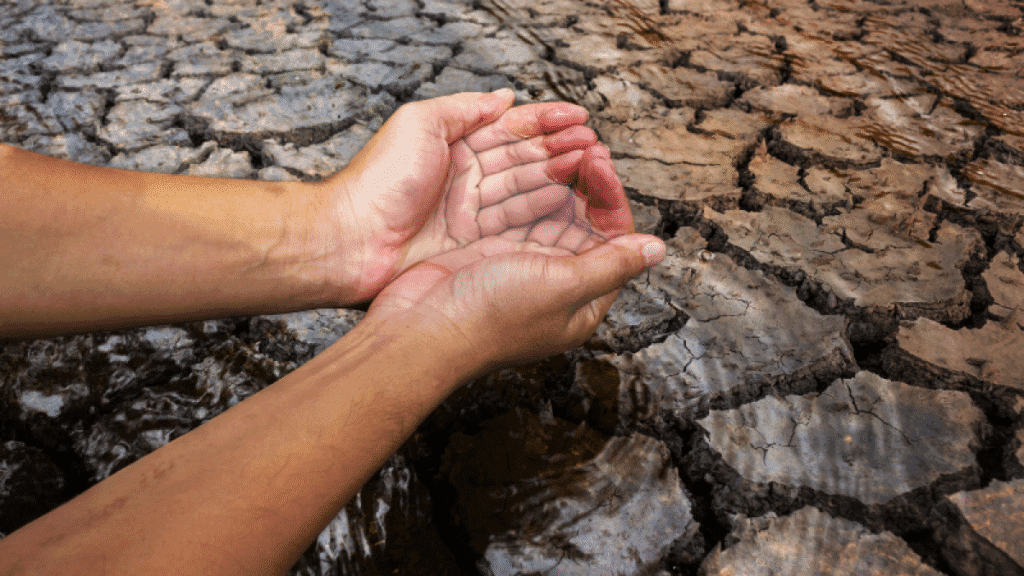
Morocco is sinking into an unprecedented water crisis. An international report published by the American Drought Mitigation Center, as part of the United Nations Convention to Combat Desertification, sounds the alarm: if nothing changes, the Kingdom could face an extreme water shortage by 2050. This troubling outlook necessitates urgent strategic choices for the country’s future.
An increasingly arid climate
Already suffering from six consecutive years of drought, Morocco sees indicators turning red. Precipitation is becoming increasingly rare, and temperatures are breaking records. January 2024 recorded unprecedented heat peaks of up to 37 °C, accompanied by a rainfall deficit of 57 %. As a result, reservoirs are nearly dry, with an average filling rate dropped to 25 %, and the level of the Al Massira dam – the second largest in the country – fluctuates between 1 and 2 %.
This aridity has led to drastic measures: ban on car washing, partial closure of hammams, prohibition of garden watering… Restrictions that could become the norm if the situation continues to deteriorate.
Agriculture on the front line
The agricultural sector, which represents about 35 % of the workforce, is one of the hardest hit. The drought affects not only crops but also livestock. In 2023, just before Eid al-Adha, meat prices skyrocketed, prompting the government to quintuple livestock imports and suspend customs duties. By April 2024, agricultural production had already fallen by 20 %, and EU forecasts anticipated a 30 % decrease in wheat and barley yields. The number of sheep has dropped by 38 % since 2016.
Towards dependence on desalination
To address the crisis, Morocco is now heavily investing in seawater desalination. No fewer than 11 new plants are planned between 2024 and 2025, in addition to 23 mobile units already in operation. However, this strategy comes at a cost: the Kingdom imports 90 % of its energy needs, making this solution structurally fragile in the long term.
At the same time, the government is experimenting with alternative methods, such as cloud seeding, which has reportedly led to a 4 % increase in precipitation and a 20 % improvement in agricultural yields during the period from 2021 to 2023.
The time for choices
With 645 m³ of water available per capita per year, Morocco is already well below the global water stress threshold. By 2050, this figure could drop to 500 m³, pushing the country into the category of nations facing extreme water scarcity. By comparison, some water-rich countries exceed 10,000 m³ per capita.
In light of this alarming trajectory, the international report calls for urgent adaptation measures: better governance, early warning systems, wastewater reuse, citizen involvement, regional cooperation… Morocco stands at a crossroads. Adapt or suffer. Act or dry up.
The challenge is immense, but it is not out of reach – provided that the mobilization matches the stakes.