

Close Menu
Greentimes
    Qoui de neuf

    MOGA Festival 2025: A study estimates over 51.5 million MAD in economic benefits for Essaouira

    28 January 2026

    FM6SS and Nareva Services Strengthen Their Partnership with a 1.2 MW Solar Power Plant in Dakhla

    28 January 2026

    Rural Development: Morocco Strengthens Its Role as a Strategic Partner of IFAD

    28 January 2026
    Facebook X (Twitter) Instagram
    GreentimesGreentimes
    • Home
    • CSR
    • Energy Transition and Renewables
    • Sustainability
    • Climate Change
    • Analyses and Opinions
    • Datas
    • Dates & events
    • Last news
    • FR
    Thursday 29 January 2026
    Facebook X (Twitter) Instagram
    Greentimes
    Home » Self-production of electricity: a regulatory framework about to be finalized.
    Energy Transition and Renewables

    Self-production of electricity: a regulatory framework about to be finalized.

    11 June 2025No Comments2 Mins Read
    Facebook Twitter Pinterest LinkedIn Tumblr Reddit WhatsApp Email
    Share
    Facebook Twitter LinkedIn Pinterest WhatsApp Email

    Morocco is preparing to take a new step in structuring its energy sector. The regulatory framework governing self-production of electricity, highly anticipated by professionals and industrialists, is in the final stages of development. According to information reported by *L’Économiste*, four application decrees of law 82-21 are expected to be published in the coming weeks, thus lifting many technical and legal uncertainties.

    These texts will precisely define the conditions for implementing self-production, particularly regarding administrative procedures, surplus management, energy storage, and production regulation. Ultimately, they will create a clear and attractive environment for both companies and individuals wishing to produce their own electricity from renewable sources.

    The first aspect: the procedures will vary according to the power of the installations. Systems not connected to the grid and with a power of 11 kW or less will only need to make a simple declaration via a digital platform currently under development. This threshold corresponds to the maximum consumption of a household. In contrast, for installations connected to the grid between 11 kW and 5 MW, a request must be submitted to the local operator (ONEE or another operator). Beyond 5 MW, authorization from the Ministry of Energy Transition will be required.

    The second decree will regulate the valorization of production surpluses. While the law allows for the sale of a surplus of up to 20% of production, exemptions will be possible for certain profiles, such as industrial units or desalination plants operating predominantly on green energy. The decree will specify the criteria to be met to benefit from this expanded regime.

    The third text will address storage. It will open the possibility for self-producers to use their own equipment or services provided by network managers. Finally, a fourth decree will regulate curtailment, this regulatory mechanism through which network managers can require a temporary reduction in production in case of an imbalance between supply and demand.

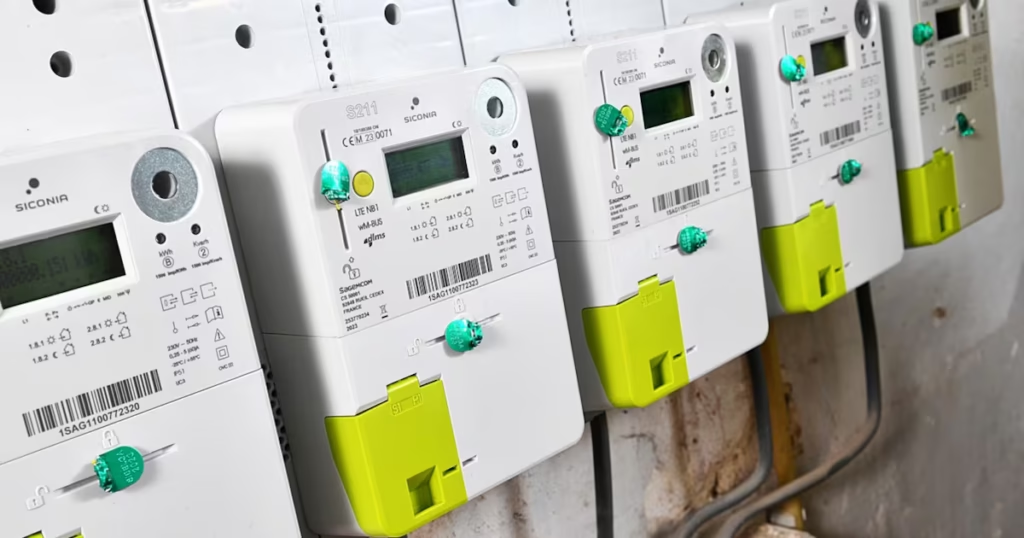
    Some obligations are already in effect. Producers must now equip themselves with smart meters ensuring the traceability of electricity flows. A certificate of origin is also required to prove the renewable nature of the injected energy, a document that can make a difference in the international market, particularly to avoid carbon taxes or enhance the environmental credibility of Moroccan exports.

    With *L’Économiste*

    about Electricity framework Regulatory self-production:
    Previous ArticleMorocco’s commitment to Africa at the center of two high-level meetings on the sidelines of the 3rd UN Conference on the Ocean.
    Next Article Macron praises King Mohammed VI’s “strong” commitment to the blue economy.

    Related Posts

    Natural Gas: How Morocco is Redrawing its Energy Map After the End of Algerian Flows

    28 January 2026

    Morocco’s Renewable Energy Strategy is Expected to Drive Economic Growth by 2026 (Mastercard Economics Institute)

    28 January 2026

    International Day of Clean Energy: Three Questions for the CEO of MASEN

    28 January 2026
    Leave A Reply Cancel Reply

    Ne ratez pas
    CSR

    MOGA Festival 2025: A study estimates over 51.5 million MAD in economic benefits for Essaouira

    28 January 20260

    The MOGA Festival has published the results of a study focused on the socio-economic impact…

    FM6SS and Nareva Services Strengthen Their Partnership with a 1.2 MW Solar Power Plant in Dakhla

    28 January 2026

    Rural Development: Morocco Strengthens Its Role as a Strategic Partner of IFAD

    28 January 2026

    Natural Gas: How Morocco is Redrawing its Energy Map After the End of Algerian Flows

    28 January 2026
    Restez connecté
    • Facebook
    • Twitter
    • Pinterest
    • Instagram
    • YouTube
    • Vimeo
    Nos vidéos

    The circular economy at the heart of LabelVie group’s initiatives.

    10 July 2025

    Mounir El Bari: “Our great ecological challenge is access to the resource!”

    10 July 2025

    Driss Nahya: “Control must be strengthened to access the waste deposit.”

    10 July 2025

    Reda Boukallal: “Priority to the valorization of household waste”

    10 July 2025
    Facebook X (Twitter) Instagram Pinterest
     
    © 2026 Green Times.

    Type above and press Enter to search. Press Esc to cancel.